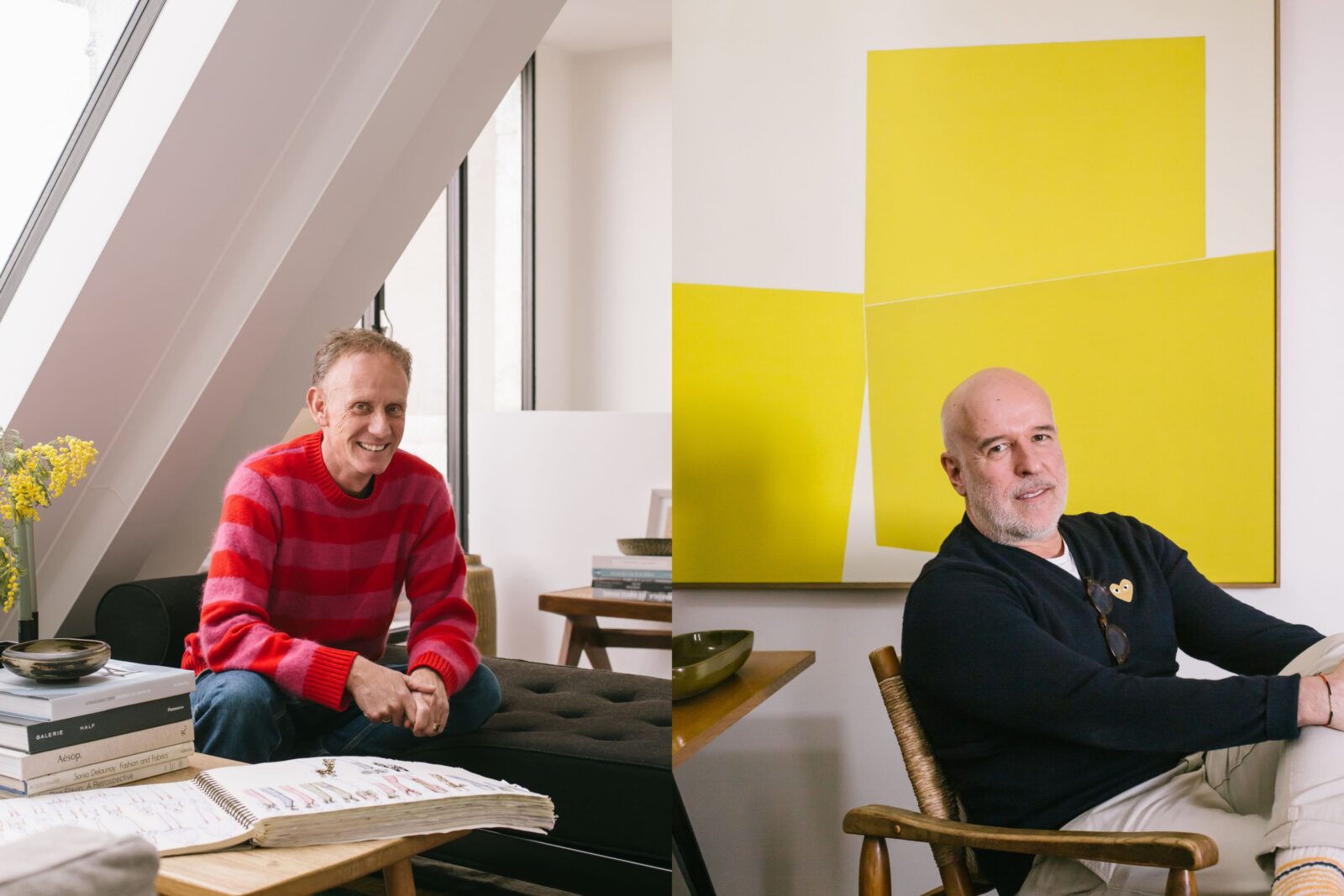
In conversation with Kim Laursen and Sergio Machado
Undercover collectors
Others might have chosen to decorate it in an ostentatious, bombastic style, but they opted for simplicity. Spread over two floors, with a terrace measuring just 5 square meters but with an incredible view of Paris, the owners of these modestly sized rooms have created an ode to simplicity.
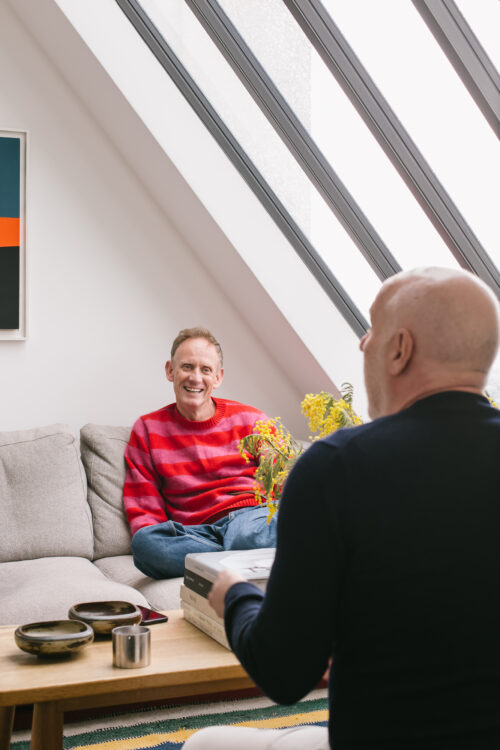
An initial conversation with Kim Laursen and Sergio Machado gave us a glimpse of their unique relationship with space, property, and time. We wanted to meet them again to chat freely about what drives them, their relationship with their (very) beautiful objects, and, above all, what makes them tick.
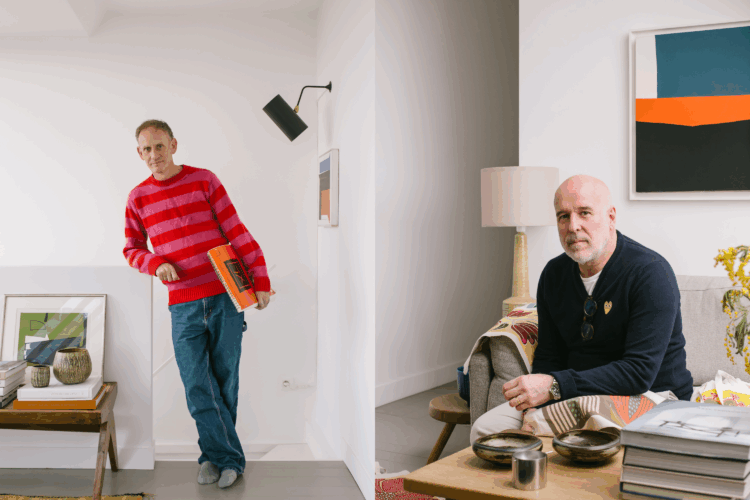
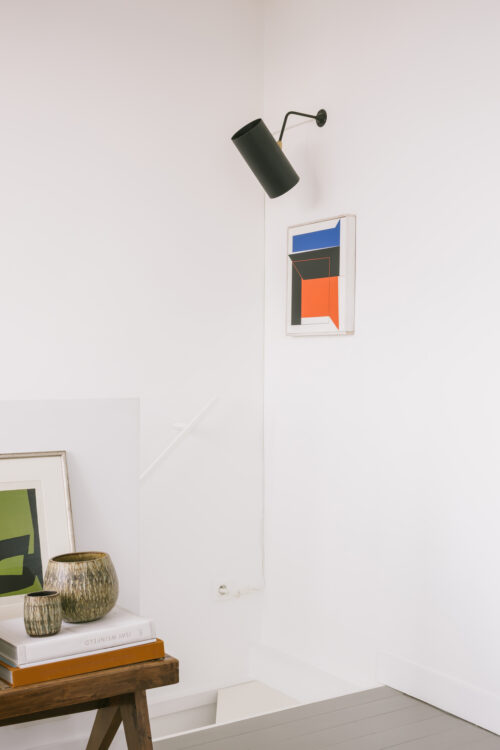
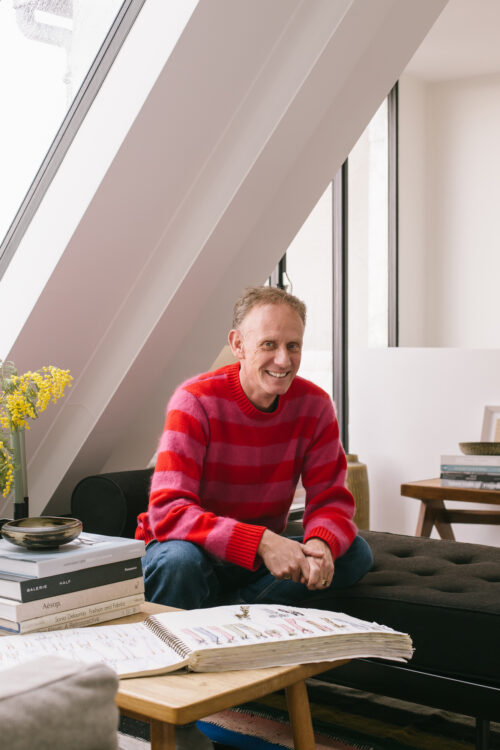
Kim is Danish, Sergio is Brazilian. The couple has lived together since they met in 2008—a year they immortalized with matching tattoos—in a very nice apartment in Montmartre. There's no elevator, just a small stairwell that smells of fresh wax, with steps that are slightly uneven and weathered by time. An astonishing warmth radiates from the apartment as soon as you step inside: the warmth of its inhabitants, who welcome you with open arms, like old friends. There are no personal photos on the walls (you'll have to dive into the couple's album to find them), but there are iconic pieces, beautiful ceramics, and designer furniture. Less like a museum than a cocoon, the place is above all a reflection of a life spent in pursuit of beauty, like searching for a rare essence. The personal collection of fashion designer Kim and textile designer Sergio defies any logical accounting system. Between Sergio's poetic little office, a Serge Mouille wall lamp, and paintings that inspire them, a powerful feeling dominates the space: that of infinite freedom.
Simplicity is evident even in the materials used in this apartment. Why did you make this choice?
Sergio: I was living on the sixth floor of this building when Kim and I met. Later, we had the opportunity to buy the floor above. The first floor already had white walls and subway tiles… We needed continuity between the two floors.
Kim: Above all, we wanted our furniture and objects to be showcased by the space around them. And I wanted a neutral setting to work in: anything “grand” wouldn’t have been right.
When we first met you, Kim, you told us that you were not very receptive to certain bourgeois conventions.
Kim: For me, opulence is no longer a luxury when it becomes overwhelming. Not to mention that the same things don’t work everywhere. Some of our friends in Brazil have green marble bathrooms. It’s gorgeous, like being immersed in an emerald, but it wouldn’t work in Paris! At least, not for me. I’m also convinced that objects need space to breathe… I say that, but I still have a house near Copenhagen that’s crammed to the rafters (laughs).
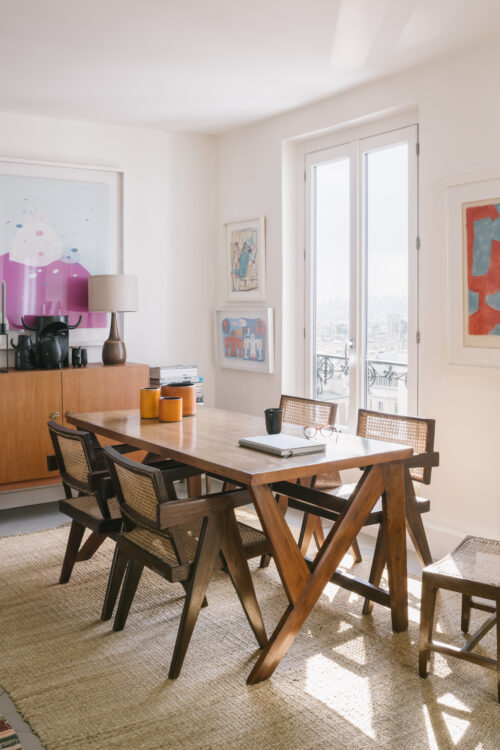
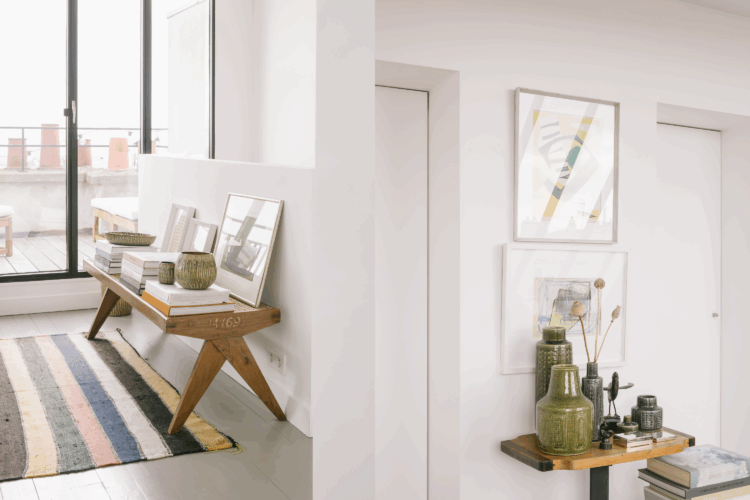
Table and chairs: Pierre Jeanneret
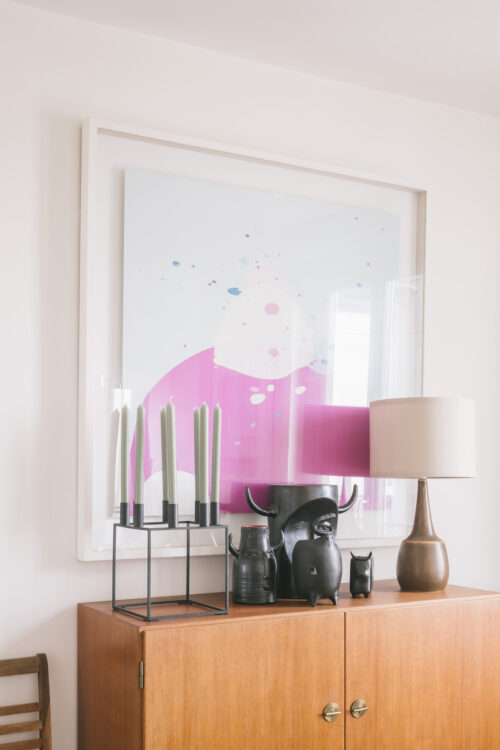
Vintage Danish sideboard
You are surrounded by exquisite objects…
Kim: I started collecting them years ago. My very first paycheck allowed me to buy a Jean Prouvé table. They are all pieces that we love, that we have a history with. The sentimental value of things is what matters most. Buying something because it’s expensive is too easy.
We note consistency in your choices; you are very
“Perriand-addicted”…
Kim: In the 1990s, I used to scour the Puces du Design flea market in central Paris. The designs by Charlotte Perriand and Jean Prouvé were considered worthless at the time: I could afford them even on my young stylist’s salary. That’s how it all started… For me, the furniture you surround yourself with is as important as the perfume you wear.
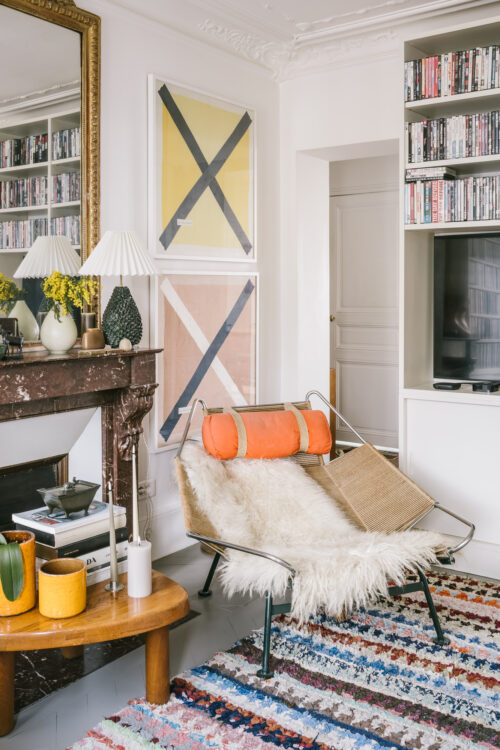
Amchair: Hans J. Wegner
Surprisingly, you don’t see yourselves as collectors?
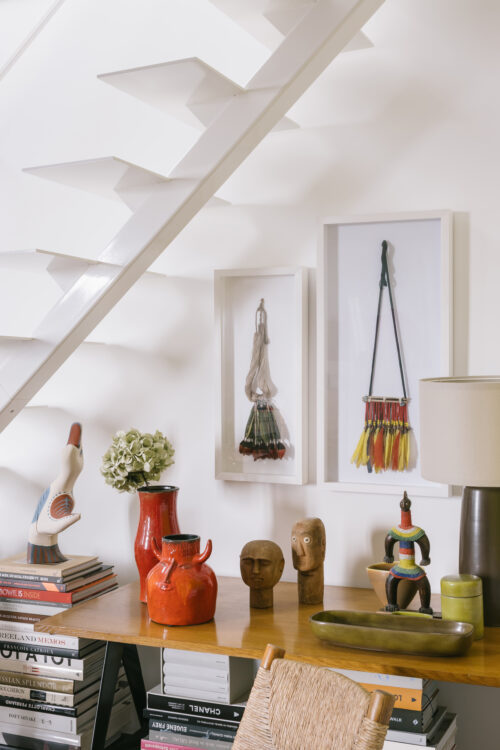
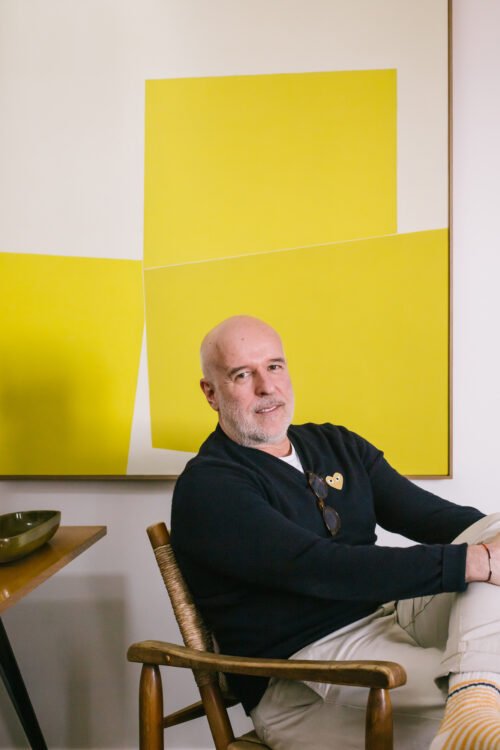
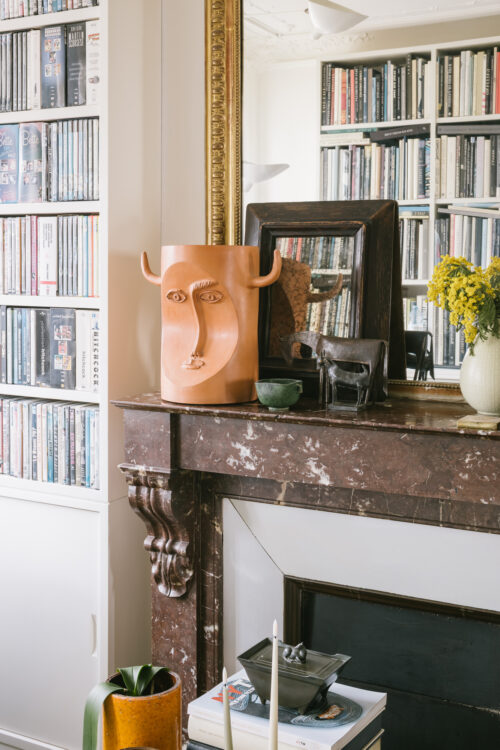
Kim: No, because I have way more desires than money (laughs). The Danish ceramic vases you can see here and there are a set I bought for 150 euros. I buy things when I find them, like these bull heads or the orange pieces under the stairs, which are French ceramics by the Cloutier brothers. Every season, I also treat myself to an object or a work of art. Like this white and yellow painting by Ludovic Philippon, which makes me happy. And you don’t just furnish your home with designer pieces: the table in Sergio’s office is a Brazilian wooden board that weighs a ton, picked up at a Maison & Objet trade fair.
Orange ceramics by the Cloutier brothers
On the wall: traditional Brazilian necklaces
On the left, on top of the books: piece of wood painted by Sergio
“With time,
one comes to understand that luxury,
is first and foremost about serenity.“
– Sergio Machado
Painting: Ludovic Philippon
Armchair: Charlotte Perriand
Sergio, your office looks a bit like a cottage.
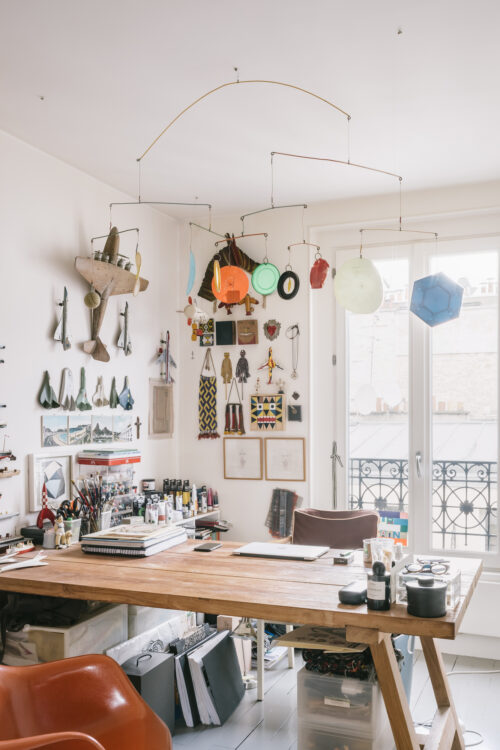
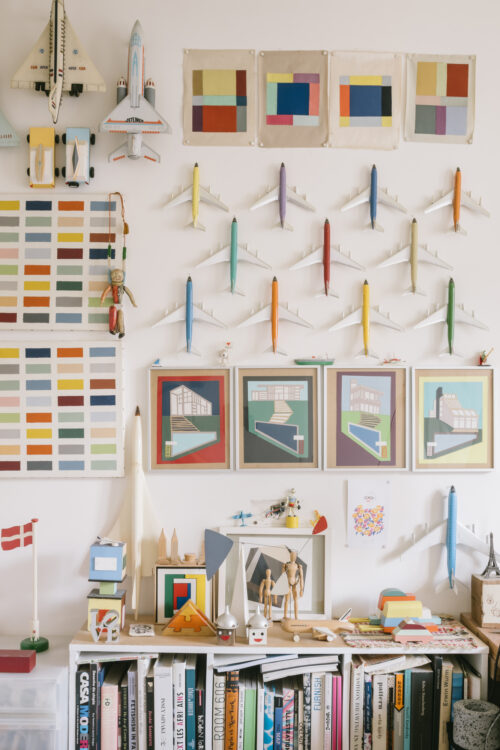
Sergio: This is my room, the only one where I can really leave things in a mess (laughs). It’s my free space! The collection of airplanes on the walls is because I’m crazy about the Concorde. The mobile hanging from the ceiling was bought at a market in Benin from a man who made unique pieces from things he found in the street: Tupperware lids, tennis balls… It looks like an African Calder! It’s old, the plastic is cracking, so I’m restoring it with tape. In fact, it’s living its own life! (smiles).
Some rooms in your home are quite small. Was that intentional?
Kim: I like small spaces. You can almost get lost in very large apartments. They’re impressive, and you can find beautiful things in them, but they’re often just a series of “dead” rooms. It can become gloomy. There’s a special comfort in living in something compact and serene, like a nest.
Sergio: With time, one comes to understand that luxury is first and foremost about serenity.
Brazilian wood table top
Armchair: Charles & Ray Eames
There is an almost innocent vibe about this place.
Kim: Something playful, actually. My luxury is having a bathtub with a view of Paris. Almost no one knows about it. It’s the only time in our lives we’ll ever have the chance to accomplish this slightly crazy feat. The same goes for the terrace: it’s not so much the size that matters as the view. Paris is so magical when you have it in front of you like that… I loved the challenge of building it. It may sound silly, but when I look at the city from this vantage point, with a glass of wine in my hand, I’m happy.
In Sergio’s office, part of his collection of airplanes, colorful charts, and books…
Is your aesthetic sensibility, your taste for simplicity, also linked to your early years here?
Kim: It’s mainly related to my culture and Sergio’s. An interior is a bit like a story you tell yourself, isn’t it? I bought the necklaces under the stairs on our first trip to Brazil, shortly after we met. And that [he points to a small sculpture in the same place] is a piece of wood that Sergio painted for me. It has a “Picassoesque” feel to it… Is it a bird or a dolphin? We’re not really sure. It’s funny, isn’t it? I also like unlikely things, like the deer from the Royal Copenhagen factory in our bedroom. When you see it, you think, “Damn, I’d never put that in my house” (laughs)! It looks like a gift you’d give to a bank manager in the 1960s or 70s… But at the same time, it has something special, a real charm.
Wall lamp: Serge Mouille
Painting purchased at a flea market
“Take what you like,
change what you don’t:
That is a fundamental belief of mine.“
– Kim Laursen
You have both lived in France since the early 1990s. What made you decide to live here?
Sergio: I’m from Sao Paulo. I came here after spending some time in London, where I started as an intern at Vivienne Westwood, then moved on to John Galliano. I followed John shortly after he moved to France. Then I left fashion to work in a trend agency. I stayed there for nineteen years. I now work as a freelance textile designer for both furniture and fashion.
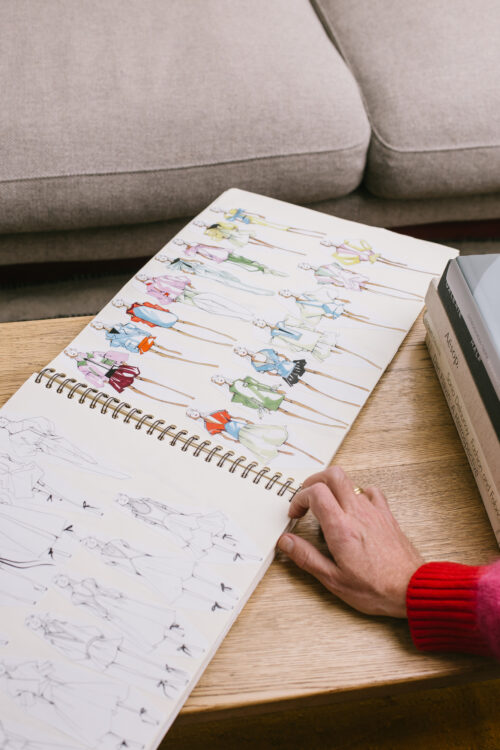
Kim: I went to fashion school in Denmark, then started an internship at Christian Lacroix in 1991. I was very badly spoiled by that first experience (laughs): there is so much kindness, goodwill, and genius in Mr. Lacroix… He was the one who gave me my start, who allowed me to be bold. Working for him is definitely what I am most proud of professionally.
Sketchbook: Kim Laursen archives
Your library, the only room in the apartment where you kept the moldings, is somewhat reflective of that era…
Kim: In the 1990s, internet use was still pretty rare. You had to read tons of books to build up your references. We can’t go back, but I still remember the pleasure of buying Vogue, I-D Magazine, The Face, all those fashion magazines… I like the grounding that books provide, the idea of shutting yourself away to leaf through them, looking for ideas in a very confined and cozy space. Working isn’t just about “doing.” It’s also about listening, watching, absorbing, interpreting… “Take what you like, change what you don’t.” That is a fundamental belief of mine.
On the antique mantelpiece, a Cloutier ceramic piece
Are you nostalgic for that era?
Sergio: It was a very different time. We would sometimes work through the night to finish a collection—it was much less structured than it is today. Much more artisanal, in the end.
Kim: There was an incredible abundance of styles, so many fashion languages… The creativity was crazy, and the stakes weren’t as high as they are now. People had time to develop their own style and carve out their niche.
Sergio, in some photos from your personal album, you can be seen at that time with Naomi Campbell and Kate Moss…
Sergio: That was because of John [Galliano], who they were very close to. There was something completely organic about the excitement we were immersed in: nothing was planned. The absence of mobile phones meant that people came and went… We were like a family. The arrogance of today didn’t exist back then. One day, someone called me and said, “I have a friend, Anita, who’s looking for a place to stay in Paris.” I had a spare room I wasn’t using. I said, “No problem! Bring her over.” Anita and I became very good friends. When she was in Paris, she stayed at my house… One of my relatives was stunned when she bumped into her one day: it was actually Anita Pallenberg [former partner of Keith Richards of the Rolling Stones]. I’d never realized it, Anita hadn’t bragged about it. She used to walk around in panties, boots, and tights, thirty years before it made the front page of fashion magazines last year. That’s how it was…
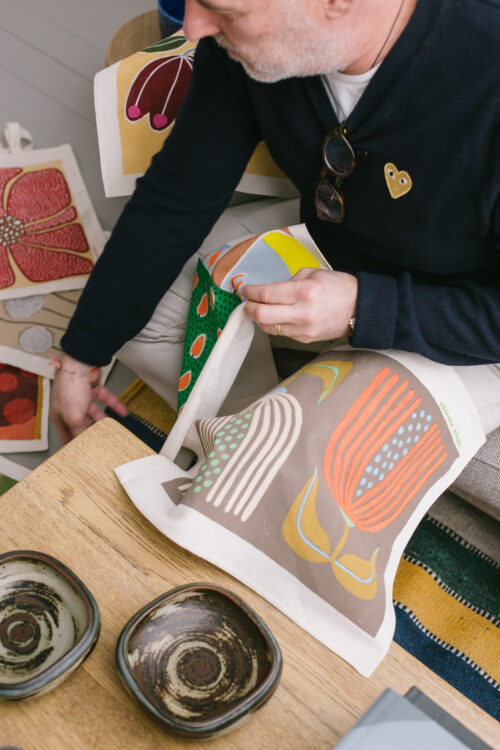
Textile creations: Le Petit Bureau by Sergio Machado
In your home, even if the walls are white, color has a special significance…
Kim: Colors are vibrant, lively, and expressive! Red isn’t just red! There are shades of navy blue, fuchsia pink… Color is wonderful to work with. It’s one of Sergio’s favorite topics, especially when we collaborate on colorful color palettes for clients. The relationship with color is like when you say about a girl, “She’s so chic!” But what does it mean to be chic? It can’t be explained, it’s not even a question of money. You either have it or you don’t.
Table: Icon Tada
Do you live differently in Paris than you do in your home in Denmark?
Kim: Yes! First of all, because we don’t have the same relationship with space. We spend a lot of time outside there. Until recently, my mother lived in this house all spring and summer. We would join her on weekends, everyone had their own living room, and we could drink our coffee in peace in the morning. Sergio would watch Brazilian TV on one side, and she would watch Danish TV on the other. She loved being with us. It’s a different way of life than here.
Sergio: It’s also a great way to live together! Over there, the doors are always open, and you move around like a breeze from one space to another…
Kim: I spend my time in the garden digging in the soil and listening to Danish radio. This garden has a kind of nonchalance, an organized wildness. It’s different here… Even though I don’t care what other people think either way! I designed this apartment just for Sergio and me. We live differently here because it’s a different vibe, a different song. Every country has its own vibe… Honestly, in Brazil, I could live with nothing.
What do you think our era is missing?
[Both, in unison:] Kindness. It never hurts.
What is the object you cherish most?
Kim: A ceramic mermaid, a very pretty gift from my mother, which is in my room.
Sergio: A model Zeppelin that my father gave me when I was a child. The propeller is broken, but that doesn’t matter.
Nous utilisons des cookies pour vous garantir la meilleure expérience sur notre site web. Si vous continuez à utiliser ce site, nous supposerons que vous en êtes satisfait.