The Microhome project, designed by the Between The Walls studio for the village of Dilove in Ukraine, is an ambitious architectural response to multiple challenges: housing for displaced people, economic and touristic revitalization, and a reinterpretation of modernist heritage.
The studio draws inspiration from the more compact architectural forms of the 1950s, such as Soviet bus shelters, to create a link between the past and the present.
The 22-square-meter floor plan is optimized with multifunctional furniture, modular spaces, and free-flowing circulation. The hexagonal shape is divided into four interconnected areas: entrance, kitchen, bedroom, and office. The central core is given over to the bathroom.
All storage units are attached to this central core, with the table and desk situated next to the windows. Between these two poles, a passageway allows for circular movement.
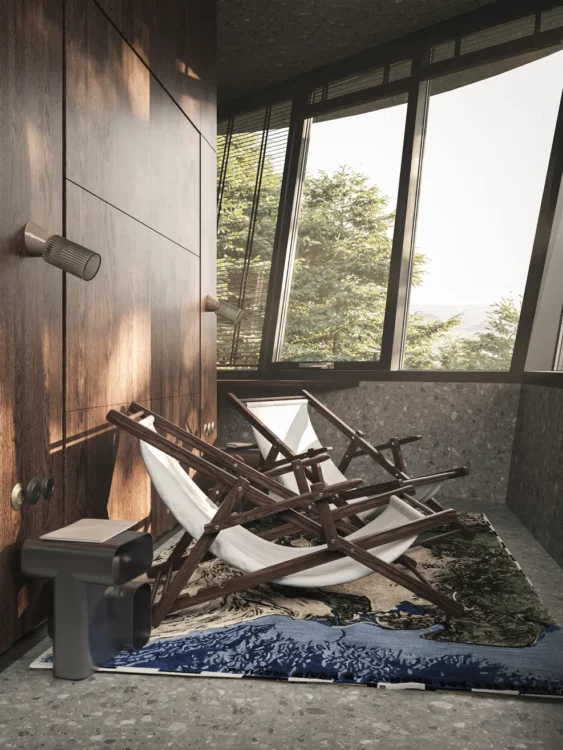
Panoramic windows offer breathtaking views of the sunrise and sunset, as well as the nearby quarry. These large bay windows maximize the connection to the landscape.
Fluid and perfectly optimized, this spatial organization is inspired by urban micro-housing, with intermingling functional areas.
In a clever use of space, the bed folds easily into a closet, making room for folding chairs and a lounge area. Modular storage units are built in to hold appliances like a washer and dryer.
Seamlessly integrated into its surroundings, the project aims to revive marble chip production in the region and uses wood as its main material due to its abundance around the site. The walls are made of concrete slabs, insulated SIP panels, and a metal frame to maintain structural integrity in the corners.
The central feature is the bathroom, which has a lowered floor and a water-resistant curtain to keep water in the room. A retractable toilet is discreetly concealed in a cupboard, optimizing space in this compact room. The sink, toilet, and tank are integrated into the cabinets thanks to a pivoting steel structure capable of supporting weight of up to 270 kilograms.
Designed for maximum efficiency, the construction process for this house is streamlined into four elements: the metal frame, the main structure for the walls and floors, the windows, and the roof. These elements fit together like pieces of a puzzle, making assembly quick and easy. But the main idea is to build quickly and inexpensively to house displaced people, collective structures (prefabricated modules, modular dormitories, etc.) with shared common areas (kitchens, bathrooms, common rooms) that encourage mutual aid are also in future plans.
The project also addresses issues of thermal insulation in extreme heat or cold, as well as preserving residents’ privacy to create a sense of security.
It is hoped that the studio will be able to develop the project in dialogue with future users and local stakeholders, thereby transforming it from a stylistic exercise into a tool for resilience or a future tourist attraction.
Nous utilisons des cookies pour vous garantir la meilleure expérience sur notre site web. Si vous continuez à utiliser ce site, nous supposerons que vous en êtes satisfait.