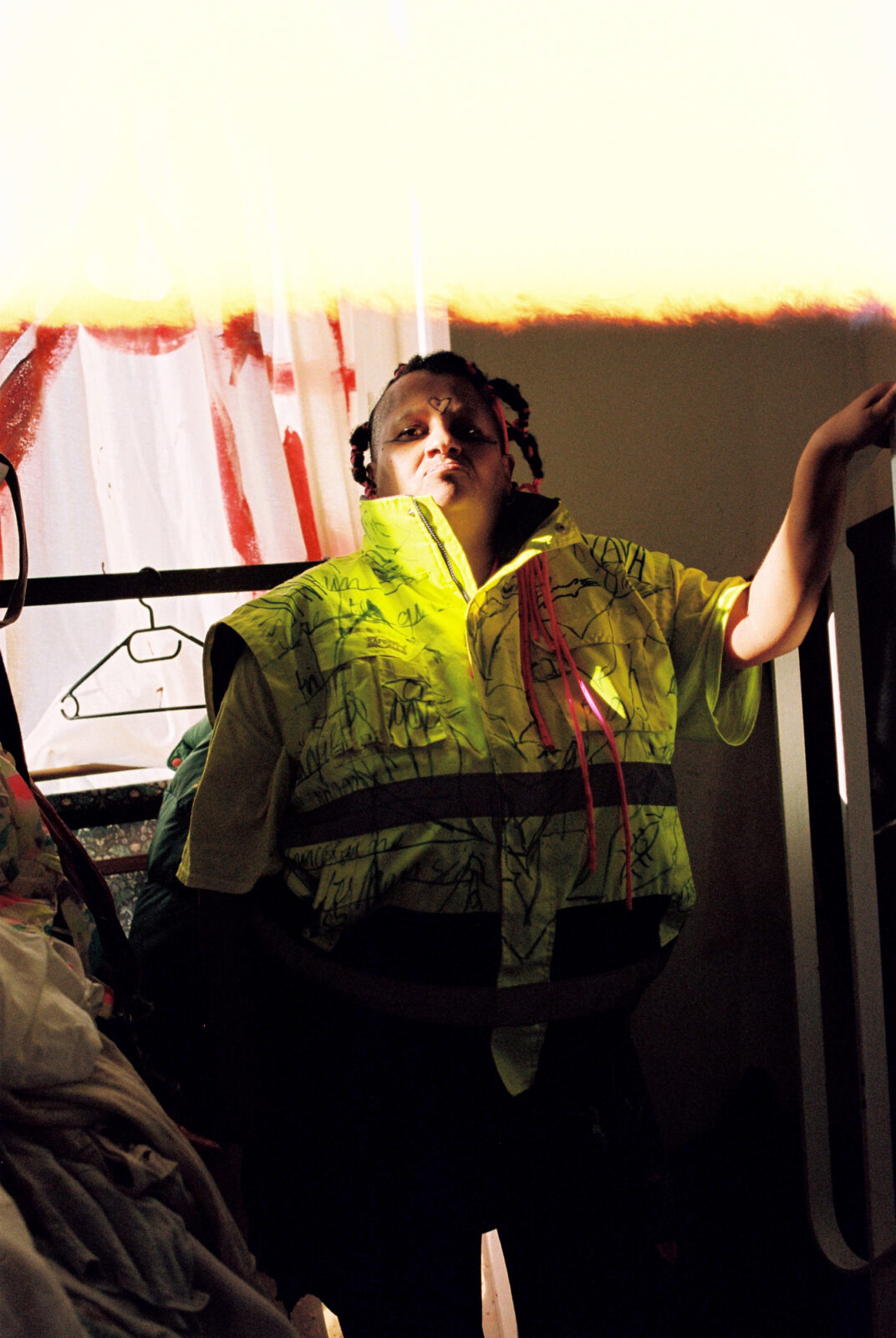
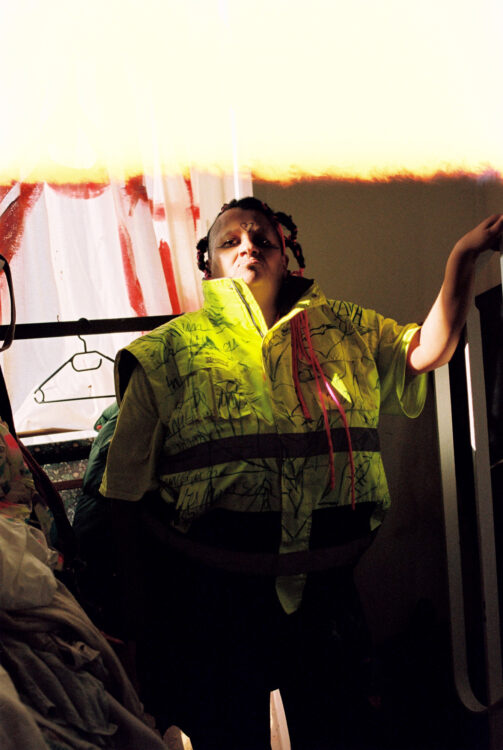
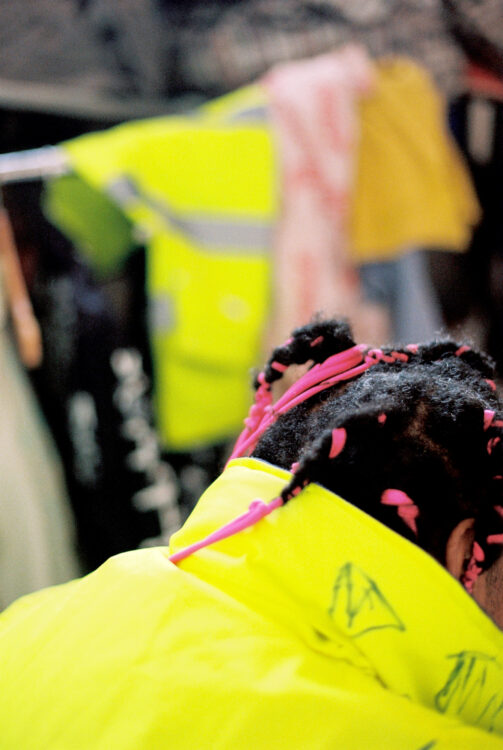
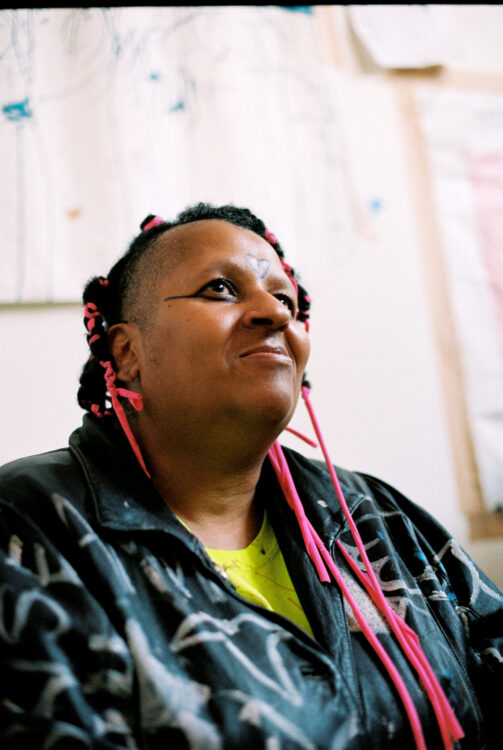
Vava Dudu is always on the move, going from one taxi to another, hopping between trains (or not, as the case may be…), exhibitions or commissions. It’s hard to keep up, especially as she’s something of a restless spirit. Since returning to Paris from Berlin in 2019, she has already had five different Parisian abodes. I am eager to discover the latest one to date, hoping that she will still be living there when I ring the doorbell.
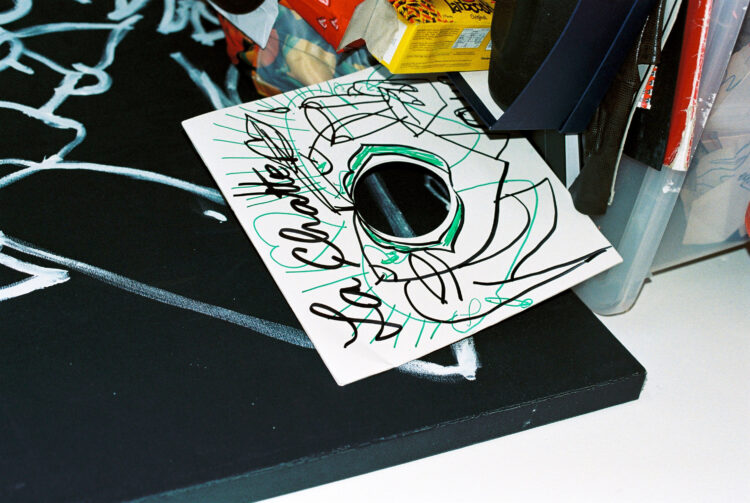
As I arrive in front of the huge concrete mound she currently calls home, graffiti plastered across the railside façade, I try and recall where I first discovered Vava. Was it in the video for Lady Gaga’s Bad Romance, where the diva was wearing a trench coat designed by Vava? Or was it when her band La Chatte played a gig at La Station—Gare des Mines? Or was it more recently at a party hosted by friends who had taken her in after asking her to redecorate an incredible Venetian apartment, which is covered in this issue? It goes without saying, the artist certainly has many strings to her bow, from fashion designer to painter, artist and singer. She’s impossible to put in a box—something that the French so love to do. Besides, she hates boxes. Forcing you to categorize. As if you are not allowed to be more than one thing or even change your identity as you please, whereas the topic has never been more relevant to the zeitgeist. Speaking of which, according to her, the woman of the hour in Paris right now is transgender model Raya Martigny, whom she met in Berlin. With Vava, it is more a case of “come into my box” or “I’m coming into yours” and “let’s turn the box into a party”. Just like at her parents’ place in Martinique. Welcome to her Kaz.
Can you describe where we are?
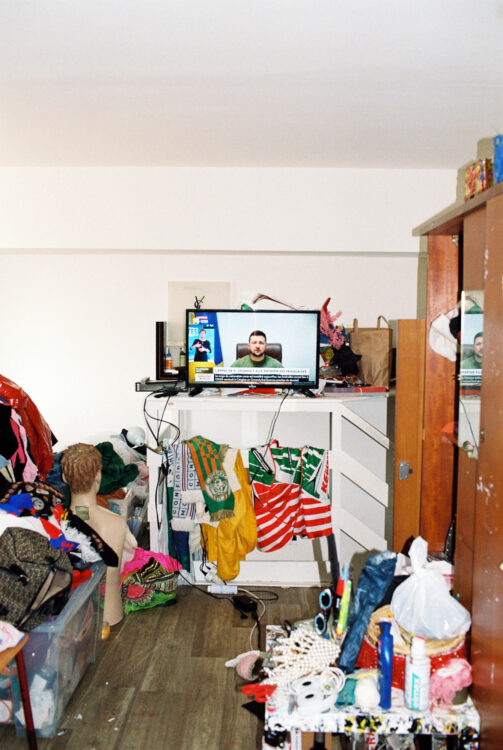
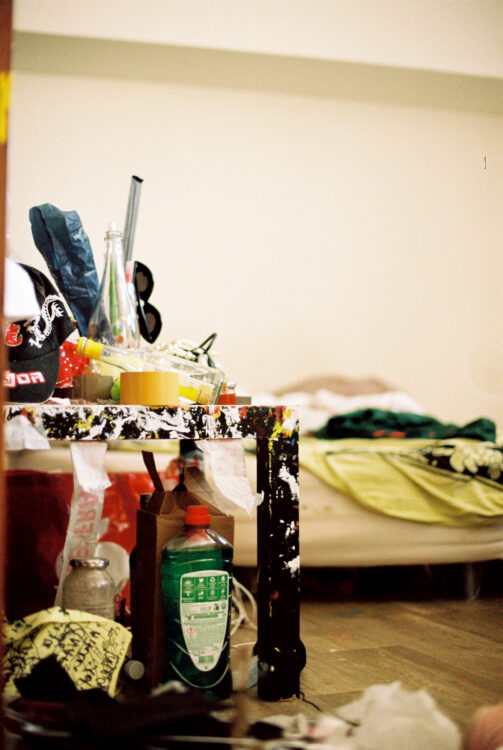
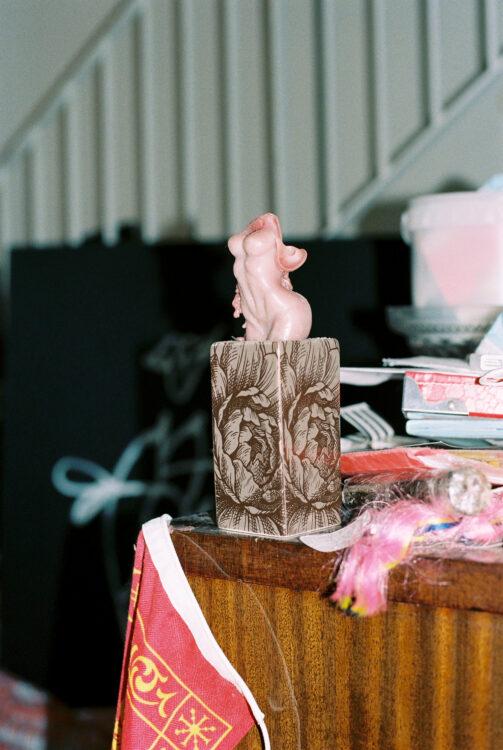
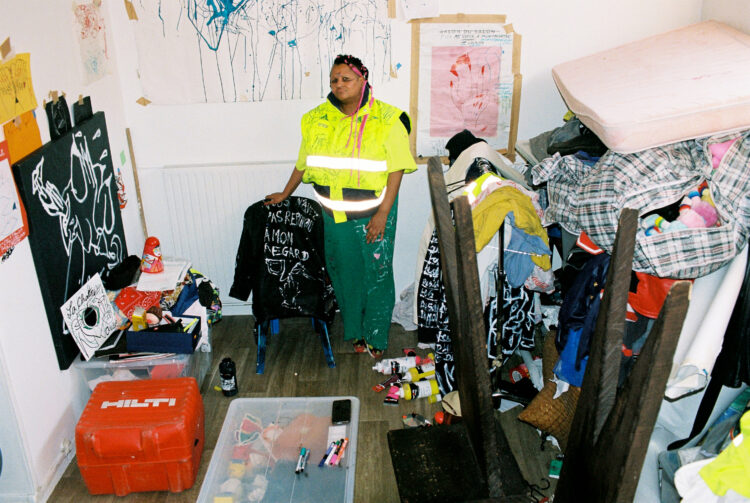
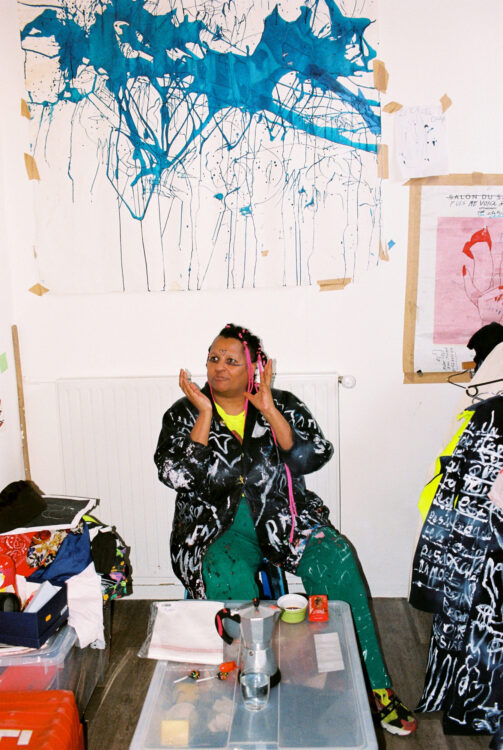
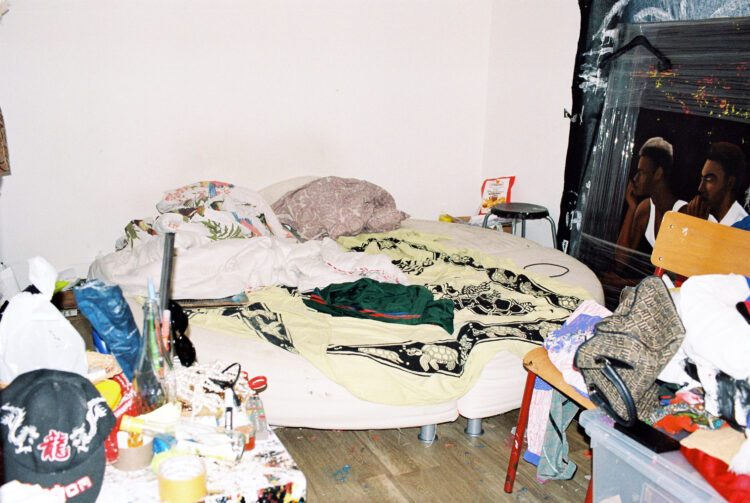
We are in my atelier where I live more often than not with Léontine, my partner. I moved in five days before the first lockdown, which immediately instilled a particular atmosphere in this space located next to Gare Montparnasse, alongside the tracks. This in itself creates a rather unusual atmosphere. Some artists did not want to live here. As for me, I find it very poetic to be around all the comings and goings, the railway lines. It’s the first time in a long time that I’m not as nomadic as I used to be. It’s been years since I had my name on a mailbox. This nest is my love nest, my place for work and for rest. This is my place for sleeping too. I was not someone who slept a lot before; I sleep a lot more now.
I lived at a friend’s place in the 10th arrondissement for a while. I lived in Saint-Ouen for a few months, and three months in Menilmontant. Before that, I was in Montmartre. And before that, I spent five years in Berlin. I was incredibly nomadic, I lived in lots of different places. And now, well, this has become my home.
Going from the 18th to the 14th arrondissement is quite a change in atmosphere, right?
I didn’t know the 14th at all. What’s funny is that where we are is a low-rise council estate. I hadn’t realized that this neighborhood had a working-class side. And then before you know it, you’re in the picture-postcard side of Paris. Once you leave this part, you soon hit Montparnasse, rue de Rennes, the Invalides. You go from a working-class neighborhood, the 18th, Barbès and the likes, to a neighborhood that is less so. Here, we’re in a small cluster of working-class houses in the heart of the 14th and 15th. These are still picture-postcard neighborhoods. You are not far from the Beaux- Arts, the banks of the Seine and the splendor of the Louvre. I love it. I feel like I’m in the heart of Paris.
Why were you always on the move?
There are two things that made me move about so much: I wanted to have an atelier, a living space with a quality-price ratio that is feasible for someone who wants to do what she wants to do from an artistic perspective. And so, when you’re an artist and you do pretty much what you love doing, that means you can’t necessarily have the perfect place, or for a long time at that. So you have to be flexible, know how to build on spaces in places that inspire you, seize opportunities that arise.
Is it easy being an artist in Paris?
It is easy nowhere and it is easy everywhere. It is an incredibly inspiring city after all. When you don’t know anything about the arts and you want to learn more, you don’t have to pay to see an exhibition, there are galleries, you can wander the streets and be enlightened by lots of wonderful things. That said, when you want to be an artist and make a career out of it, or at least step into their shoes or be famous, be seen, or express what you are as an artist, then I would say yes, it’s fine. But it is not so much a question of being easy or not, but more so whether you feel good or not. Some days everything seems great, you’re like a blank page that inspiration takes over.
You left Berlin, returning to Paris to make it your home.
I was born in Paris. It’s true, at one point I definitely got fed up with Paris. I thought I would never go back when I left for Berlin following a breakup, following a lot of things, let’s call it an all-round breakup. Love, work… The city no longer suited me. I wanted to find something more music-heavy, more club culture-centric, try things, try nothing, spend hours just staring at the ceiling. Things that Paris does not allow you to do as much. In Paris, people walk much faster, there is a real rhythm to walking. As soon as you set foot in the metro, you pick up this pace. People don’t walk like that in Berlin. I found myself reverting back to racing around when I came back to Paris because I was working on certain things, and then all of a sudden, you’re rushing around as the things to get done in a day mount up. But it’s great, because when you’re on a personal quest of self-discovery, it puts a spring in your step. Berlin, on the other hand, is action in reflection. It’s more a place where you have time to think, time to stare at the ceiling. I literally spent hours doing this. You have time to figure out what you want to do – or not do – with your life. Do nothing before starting to do things again.
You were unfaithful to Paris.
Exactly. It was like having two mistresses. I see Paris as a big, mixed-race blonde. A Catherine Deneuve type crossed with lots of different things, an afro-haired Catherine Deneuve. Berlin is Nina Hagen, the music, the Bowie myth, the Christiane F. fantasy, the nightlife, the music.
Berlin is night and Paris is day.
Yes, but a brunette can be diurnal too! I also led an incredibly nocturnal lifestyle in Paris. But before you know it, it’s a city that forces you to work because the cost of living is high. Especially if, like me, you get around by taxi! So what do you do, you want an atelier and all the rest of it. Even if Berlin is a big city, there is more of a village feel to it, more natural, it’s greener, there are lakes. The two cities complement one another. Now I live here. In Berlin, when someone asked me where I was from, I would say: I’m a Parisian. When you’re Parisian you can also be from the French West Indies. The Parisian might also have Algerian, Japanese or Cameroonian roots, it’s a melting-pot identity, a cosmopolitan city. That is why whenever I’m abroad I like to say that I’m Parisian. I have hardly ever lived outside the capital, but I am starting to do residencies in places like Poitiers and Bordeaux.
Does the Grand Paris project appeal to you?
Yes, we must continue in this direction. More transportation, more trams, having some nice bars beyond Saint-Denis, beyond Montreuil. People who live further out must want to come into Paris and vice versa. It makes a city that could easily die out in its old bourgeois-bohemian ways a little more buzzing. After all, a city is designed to act as a catalyst for encounters and exchange. That is where its interest and its strength lie.
The Grand Paris project is like the air that allows the city center to breathe.
Exactly. When I was little I lived in Sannois near Paris, and as a teenager I would take the last train from Gare du Nord. It was not Gare du Nord as it is today! So, at a certain time of day, it was very difficult to go to and from Paris. When you went out at night, you would stay over at a friend’s place.
Do you live in an atelier or work in an apartment?
[laughs] I live in an atelier. I can’t live without having an atelier.
Some artists like to keep home and work life separate.
I have that separate workplace experience when I am doing a residency. It means I can have bigger, different spaces; I like that these spaces are transient. You discover a new place, the vibe is different. That’s what I find interesting. On the other hand, if I had an atelier and I had to clock in and out… Nah, being in an office is not my thing. I love being able to work in my underwear, the intimate workshop vibe.
What is it like living the high life of fashion shows and gallery openings, with all those people who get drunk on being surrounded by artists, who buy art and then go back to their fancy houses…
Well me too, I go back to my studio! When I create a collection or an exhibition, it gives me a thrilling boost of energy knowing that there is a fashion show or an opening at the end of it. You get feedback on your work, these are celebratory moments, and I do love champagne. Returning to fashion week really did me good. It’s a bit like Paris Carnival. When I was a teenager, I would make photocopies of invites so I could get into shows because I didn’t know anyone. I would go with a friend, we would crash them all—Gaultier, Yohji Yamamoto, you name it. Everyday life is a routine— even if you’re an artist. So breathe, it’s important for the mind.
Do you not feel like you’re putting on some kind of show for rich people?
I don’t care. Because if the wealthy people weren’t there, who would buy it? “Who buys art?”, that was my all-important question. Or an item of clothing? Who goes to the fashion shows? When you don’t know anything, when you’re a kid and your mother doesn’t shop at Dior or wherever, you wonder who goes to the fashion shows, who buys those dresses? When I started making accessories, I made things that were sold at prices in stores that I could not afford to shop at as a young designer. For me, the notion of value lies in what I do because I love what I do. And if there are people who like what I do and have the money to buy it, great! The funny thing about my artwork is that I managed to interest people who had never bought art before and they purchased my work. They bought a shirt and framed it! Even though I told them that it was made to be worn! I think it’s sweet, I think it’s cool. I will never turn my nose up at fashion week or collectors. There are all types of collectors. There are billionaires, of course. But there are collectors who have nothing. I won’t go into details, but for example, there is someone who collects my work, they are not welloff, but they are loyal, they take out loans, keep me updated on their life, ask me to reserve artwork for them, pay me in installments. We have been functioning like this for two years. Art is linked to desire
Do you chase after prizes, academic honors or recognition?
You’re chasing trains I’m not on! [laughs] I recently had to fill out a form to give a lecture at a major university abroad. They asked me for my diplomas. But I don’t have any. I consider my diploma to be the ANDAM (the French National Association for the Development of the Fashion Arts) prize I won in 2001. That was when I was told: “OK, you have a value”, “Your work is cool”. We’re talking about people from LVMH and the likes. Today it carries even more weight. If you would have said to me, “You are going to have an agent, you are going to go to Japan” with whom I have since developed a very strong relationship, I would not have believed it. For me, winning this prize was a bit like getting my high school diploma. That is what I put on the form. I wrote that I left school at 15, that I did a foundation course at the Beaux-Arts (Académie Grandes Terres) and at a small fashion school (Fleuri Delaporte), but that I started working at 16. I also won the Prix de la Jeune Création de la Ville de Paris, an award for emerging talent. I wasn’t very academic, but I was enthusiastic because I was creative. These prizes sort of certified what I was doing all by myself. Labels are important in France. Just because you quit school doesn’t mean you haven’t got an appetite for knowledge. I spent my life in the library. My problem was with authority.
It is true that the French education system is extremely vertical.
Didactic. Very didactic. Things are done in a certain way. And when someone tells me “no”, I say “yes”.
You love Paris, but when you look at its architecture, everything is in perfectly straight lines. There is not a line out of place. There is a certain rhythm and authority to it. It rubs off on the locals’ style. They have this structured, discreet elegance which epitomizes Parisian style. Whereas you, you stand out in this landscape.
Sure, I love modernity. Maybe that is why a city like Berlin, with its complicated and chaotic history, speaks to me too. I discovered it just after the fall of the Wall, when everything was an excuse to party on a shoestring. There is something very immaculate about Paris, it is very Catherine Deneuve, and as far as I know she is really nice and funny in real life. Paris is very nice and funny too. Paris is teeming with places that are less chaotic than in Berlin, but sumptuous places where you can exhibit, party, hold a workshop, whatever. It is not as narrow-minded as you might think. From the outside, there is this majestic facade which may be intimidating, but you can get into her old lady wrinkles and God knows there are a lot of them! I never felt rejected by Paris despite the articlesabout me at the beginning, like “Who’s afraid of Vava Dudu?”. Even friends told me that I scared them at first. I didn’t exploit this, I never understood at what point I could scare people. My parents kissed for the first time on the steps of Montmartre. They said yes to one another. I am Parisian.
Can you tell us about the apartment in Venice that you helped decorate?
I had never been to Venice before. I first met Marc at a party, where he told me about his plans to buy an apartment in Venice. I discovered the place my first trip there. Marc had this desire to create something special. He asked for my advice. I introduced him to Federico, an architect friend, to work together with the architect commissioned by Venice’s local authorities. They worked together and from time to time, I would go approve things, give advice on the colors, the flooring. And then later, I did the household linen, the cushions, the mural and, not forgetting, the Totem kitchen design. It was Federico’s idea, because the kitchen area was very small. So he came up with a decorative sculpture for the living room that would contain the entire kitchen. You can’t miss it. And since it’s made of colored Plexiglas, it takes on different forms depending on the morning and evening light.
Is this your first interior design project?
For an apartment, yeah. I have been asked several times to do wall paintings. I did one in front of my home in Montmartre when Arte came to interview me on camera. I told them that I had done a small painting. It ended up covering an entire wall of my apartment block. I actually like doing large drawings, like what I did for my exhibition at the Palais de Tokyo this year. In Berlin, I did one for a restaurant, a bar and a few public places. I get more and more requests to do wall, paintings in people’s homes.
The ones in Venice are very beautiful with their golden paint.
Yes, there is a dialogue between them and the door curtains made from strips of leather. At first, we wanted to make beaded curtains using Murano beads to extend the notion of light. Or even like what you’d find in the French Antilles, with multicolored plastic strips. Then suddenly, we said to ourselves: why not leather? So I cut up a large tanned hide that I had found and I painted the patches.
You could call it Dudu House. It is not Pierre Frey, but Dudu Maison.
[laughs]. We could have made some furniture too. You see these chairs, I designed them for my first showroom. I had also designed a table and screens to display my woven bead jewelry.
You are a dab hand at salvaging, capturing the past life and story behind an object.
Both. I’ve always liked salvaging things. It’s less about not wanting to throw things away, but more so because when I started making collections with my partner Fabrice Lorrain in the late 1990s, early 2000s, we would go to Emmaüs charity shops and back then, all you would find is Margiela and big-name labels, which were extremely interesting for making something new with, and very few designers were doing that. It wasn’t called upcycling at the time. I also like starting from scratch, from a blank material or a worthless new object to make something that suddenly acquires creative or artistic value. I am not in the past. I am scared of getting bored.
Nous utilisons des cookies pour vous garantir la meilleure expérience sur notre site web. Si vous continuez à utiliser ce site, nous supposerons que vous en êtes satisfait.