 For Sloft+ members only

Living by the sea and having only one view of the outside world? This would be a dealbreaker for many buyers… But architect Olivier Rozé doesn’t dwell on such considerations, and instead reveals the full potential of a semi-blind room in Saint-Malo, quickly transformed into a welcoming pied-à-terre.
Parisian architect Olivier Rozé regularly travels all over France to follow up on his various projects, but he has a special bond with the town of Saint-Malo, where his son has lived for the past ten years. With the development of his professional activity on the west coast now providing him with many opportunities to visit his son, Olivier Rozé is determined to acquire a pied-à-terre in Saint-Malo. The latter must be versatile in order to accommodate family, friends and business relations as required.
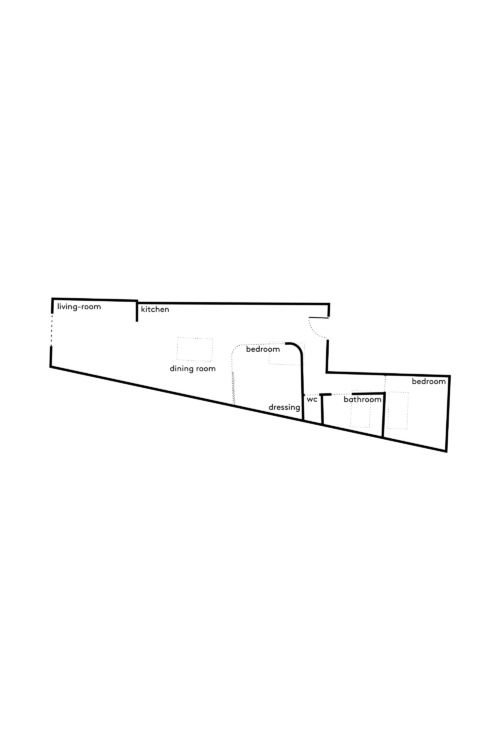
After several years of fruitless searching, the architect finally stumbled upon the rare gem of his dreams! On the first floor of the former Hôtel Victoria, dating from the end of the 19th century, is a 47-square-meter space in which Olivier Rozé immediately saw himself. Situated on the seafront, a 15-minute walk from the ramparts of the old town and 2 minutes from the heart of the Saint-Servan district, the property is ideally located. However, its atypical volume would have discouraged many. The apartment’s trapezoidal shape makes it difficult to fit out, and the most striking feature is the one and only window. However, the space is not lacking in natural light! Four roof openings allow the sun’s rays to penetrate all the way to the back of the future home.
Olivier Rozé was not intimidated by these characteristics. After considering the need to maintain a visual dialogue with the outside world from every room in the apartment, the architect set about transforming this raw space into a functional home. Conceived as a true 3-room apartment despite its reduced surface area, the apartment, designed for hosting, working and living with the family, relies on a simple yet warm decoration to make you forget the spatial constraints the architect had to face.
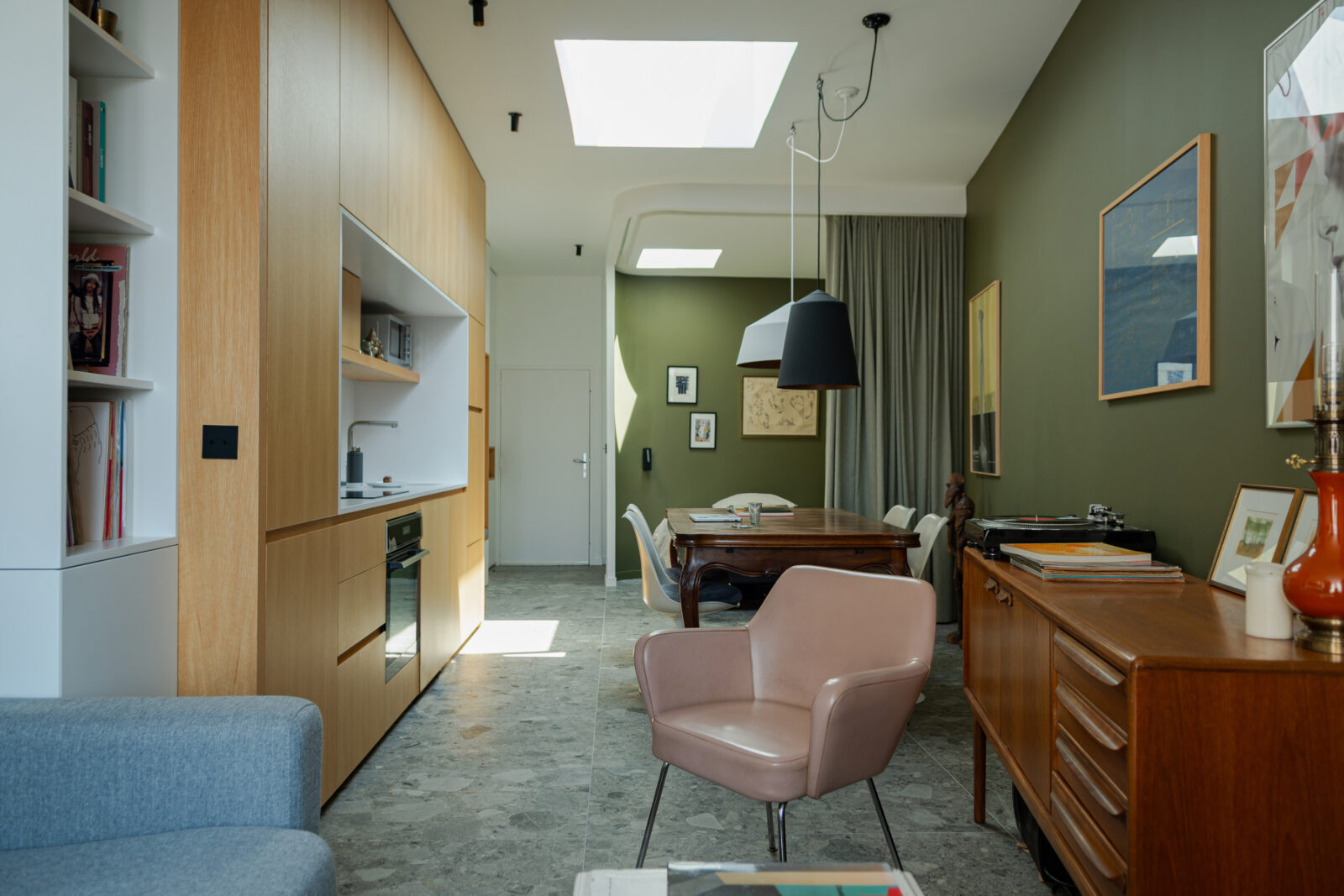
“The complexity of the layout led me to make joinery the real added value of the project. It partitions, resizes, welcomes, hollows out, makes disappear… Its functional thickness frees up spaces, defines their limits and frees up circulation, while its skin changes color and material. It has made it possible to achieve a certain minimalism in the layout in the service of functionality, while at the same time giving character, but also softness, to the whole,” explains Olivier. Curtains also play an essential role in the architect’s quest for functionality and softness, enabling him to transform this soulless room into a warm cocoon!