 For Sloft+ members only

“A massive dumpster!” You couldn’t find a more drastic term than the one Marion Piednoel used to describe the place she and her husband set their sights on in 2017 to make their home. “I needed a blank canvas where everything could be imagined and built,” says the interior designer enthusiastically. The former carpenter’s workshop, with its three lopsided spaces, fixed windows and “absurd” layout, fully met the young woman’s expectations: “I was looking for the worst possible place to completely transform it, to make it into something totally different from the renovations I’m used to carrying out.”
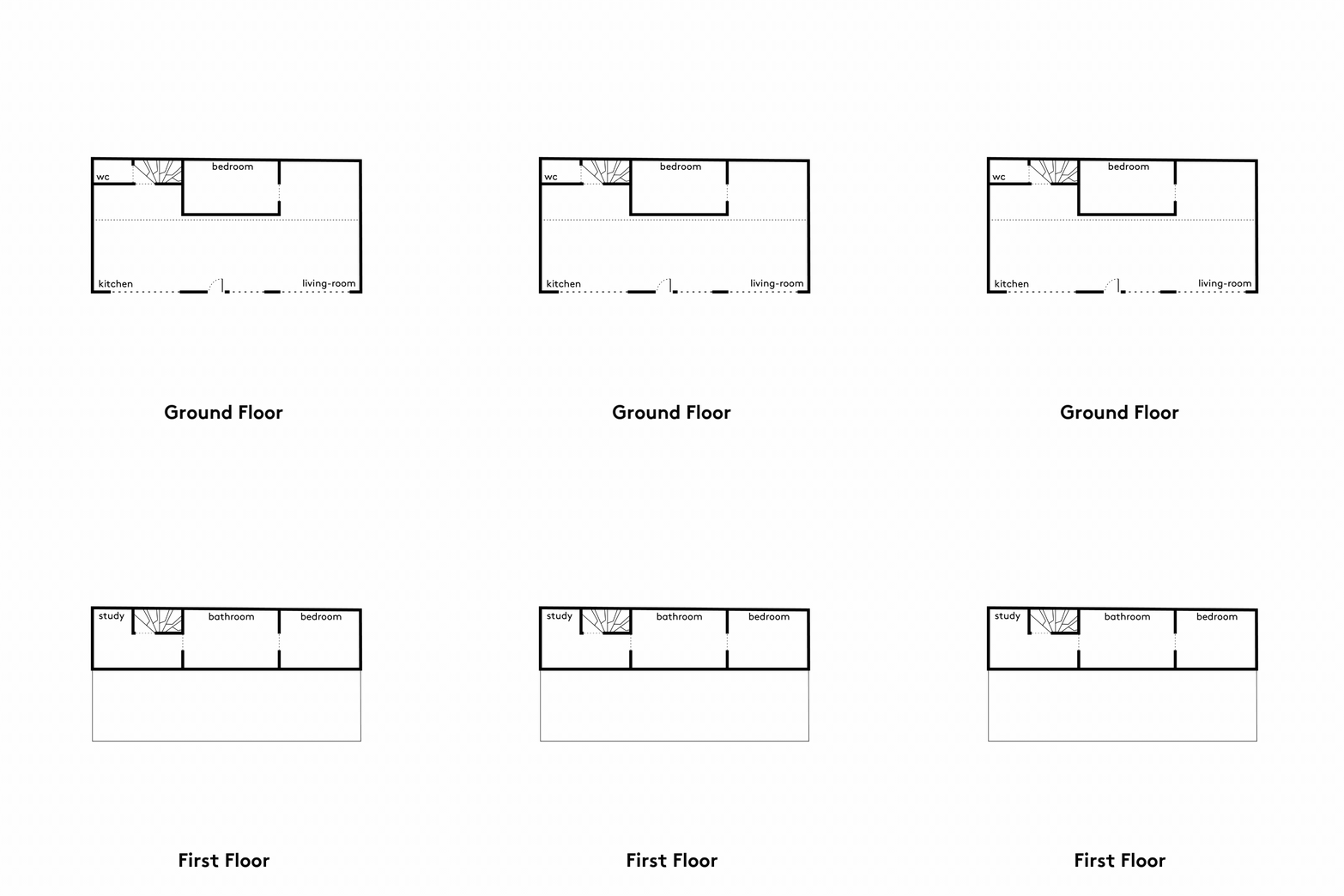
First job: “Convince my spouse !” Then excavate the ground sufficiently to achieve a ceiling height suitable for creating two distinct levels, each with its own Carrez area (effective usable surface area). A monumental task that was bound to cause its fair share of cold sweats: “At the first blow of the jackhammer, I saw Marius, my partner, turn pale. And yet, that was the only reason for the project’s existence.” Marion decided to divide the resulting generous volume lengthwise: “The idea sparked debate among my architect collaborators, and yet, if built across the width, the mezzanine would have overwhelmed the overall volume, as well as the views. Beneath it, one would have felt suffocated. Whereas here, the space appears even larger.”
Like a metal footbridge, the ultra-slim steel structure (10 centimeters) easily accommodates a small office, the family bathroom, and the primary bedroom. The latter opens directly onto the living room. A manifesto? “I designed this space as a succession of beautiful volumes,” continues Marion, as she evokes the unconscious influences of Robert Mallet-Stevens, visual artist Donald Judd and sculptor Carl Andre. “I wanted the result to have a strong visual impact, but also to be as relevant as possible to our own living scenario. The mezzanine was not to become the project’s antechamber.” Breaking with convention, without ever forgetting technical imperatives: a statement that can be found all the way to the Japanese staircase. Or even in the bathroom above. The rim of the suspended bathtub is flush with the floor, thanks to another recessed area: “The trick allows my husband, who is tall, to shower without brushing up against the ceiling, which is only 1.90 meters high in this area.”
Even before having children, the couple had decided to live without any doors other than those for the toilet and the sliding doors in the shower, “in as open a space as possible, in line with our desire to entertain a lot. The idea, too, that each of us should evolve according to our own rhythm and activity, while maintaining a permanent connection with others. Iris and Karl, our two children, were raised in this spirit.“
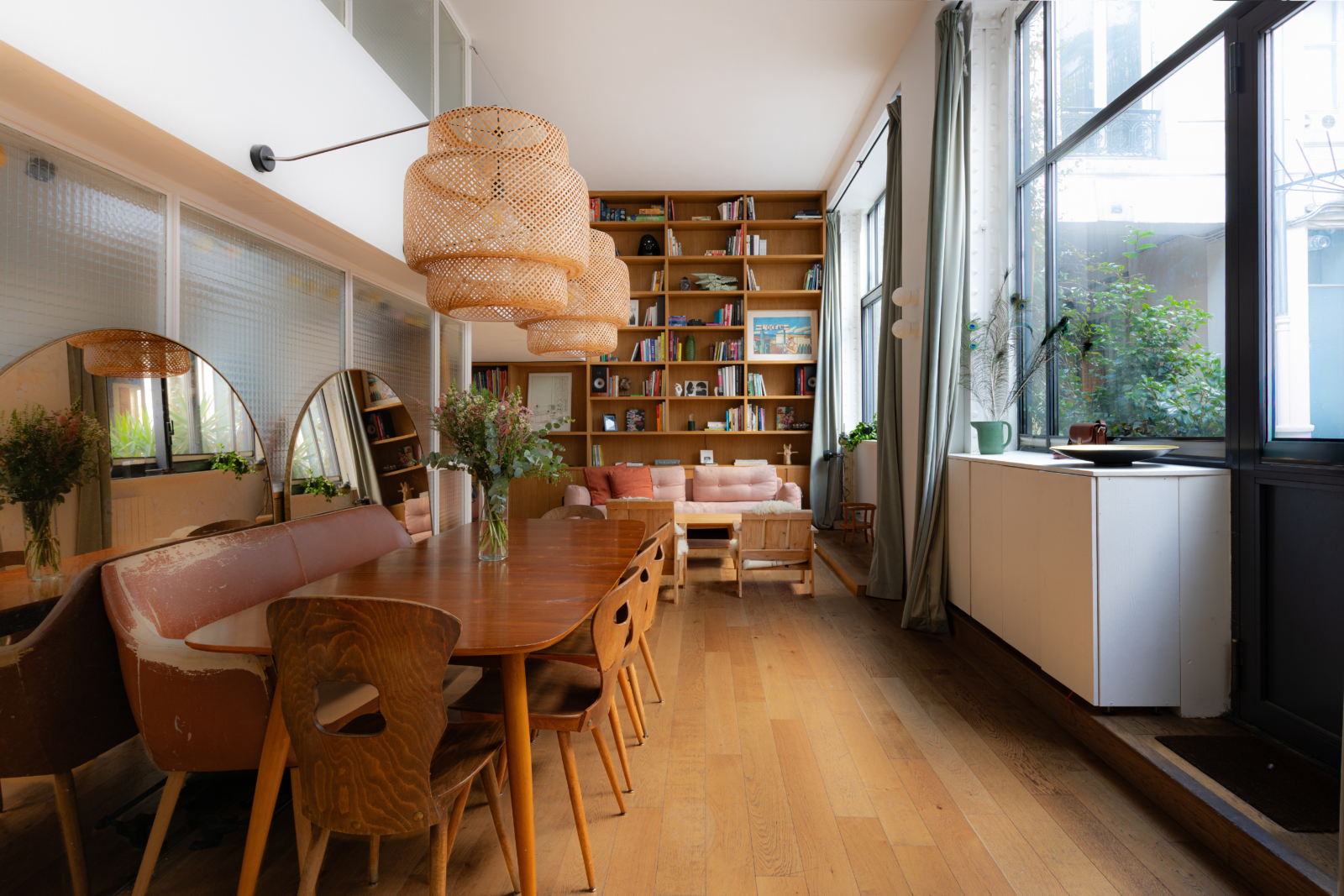
Designed for the early years of family life, this space—which opens entirely onto the courtyard and is shielded from view by Roman shades and the clever use of perspective by the founder of the Enoplide firm—has ultimately proven to be a long-term solution. “Some recent additions, such as the fold-down beds in the children’s room, have helped save space. We’re also lucky that the children—now eight and five years old—refuse to grow up in separate spaces.” Proof, if ever there was any, that the space in which people live can shape their life choices?