 For Sloft+ members only

Alexis deplores that “curateur” doesn’t have the same potency as its English counterpart: “There is such a thing as ‘curateur de musée’, but that’s a bit reductive.” Be that as it may, the term perfectly defines the hunt that the forty-something went on to furnish his apartment- cum-gallery with rare pieces by designers or architects.
The former advertising creative director – who could tackle subjects ranging from fashion to the more industrial applications – has always had a passion for 1980s furniture: “In the 1970s, everything looked the same, and from the 1990s onwards, globalization led to a downward shift in quality.” During his business trips, he always paid attention to the smallest details in hotels, contemplating at length a light switch here or a particular assembly of materials there. “It was also fascinating to find almost museum-like pieces you’d otherwise only come across in galleries.”
The pandemic inspired a change of track: he began designing modular rental spaces, grouped under the Haute Renommée Gallery banner, which could double as apartments, coworking spaces, meeting rooms, or even showrooms: “This collection of spaces forms what I call an ‘exploded hotel,’ whose rooms would be scattered all over France.”
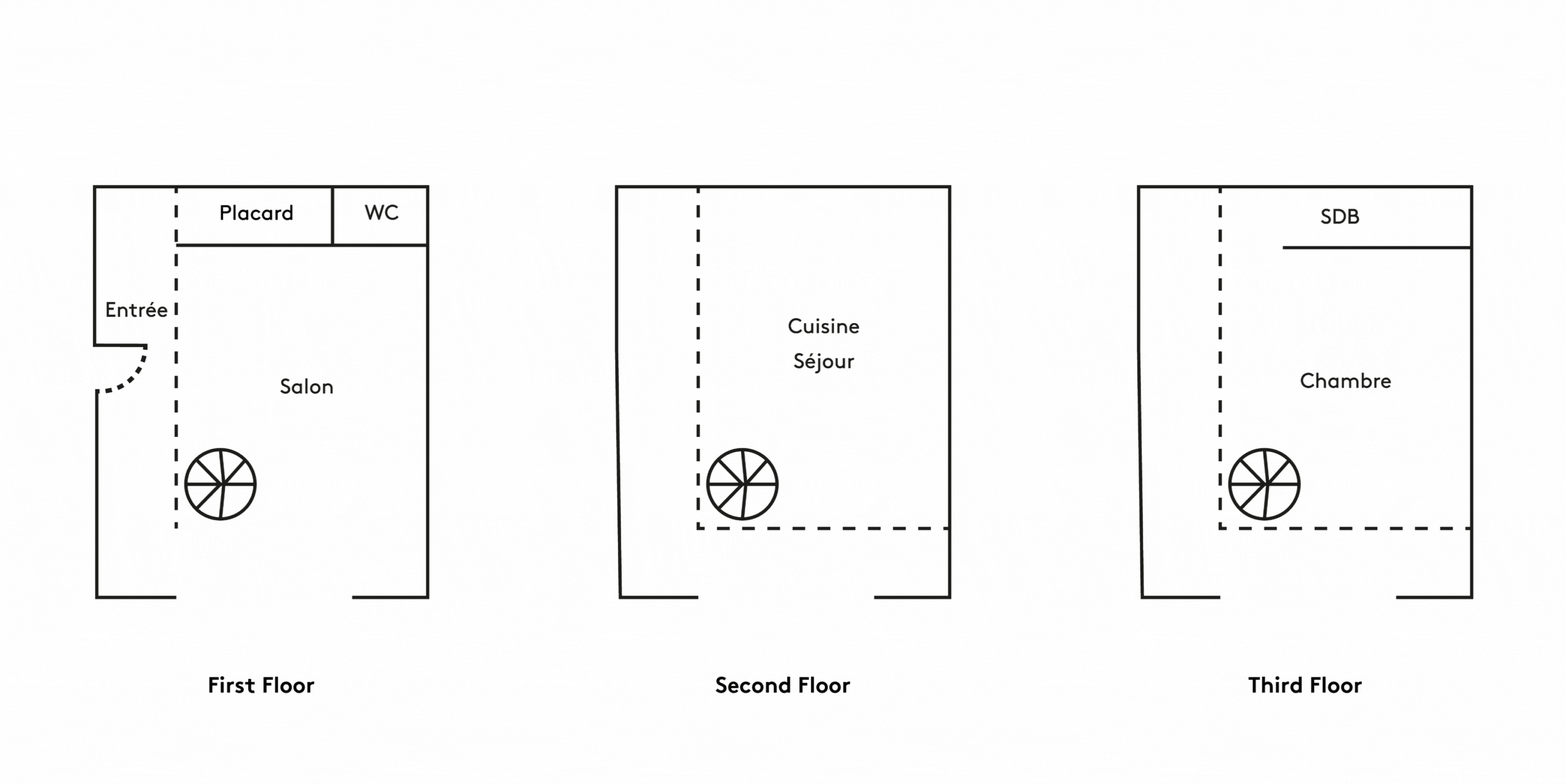
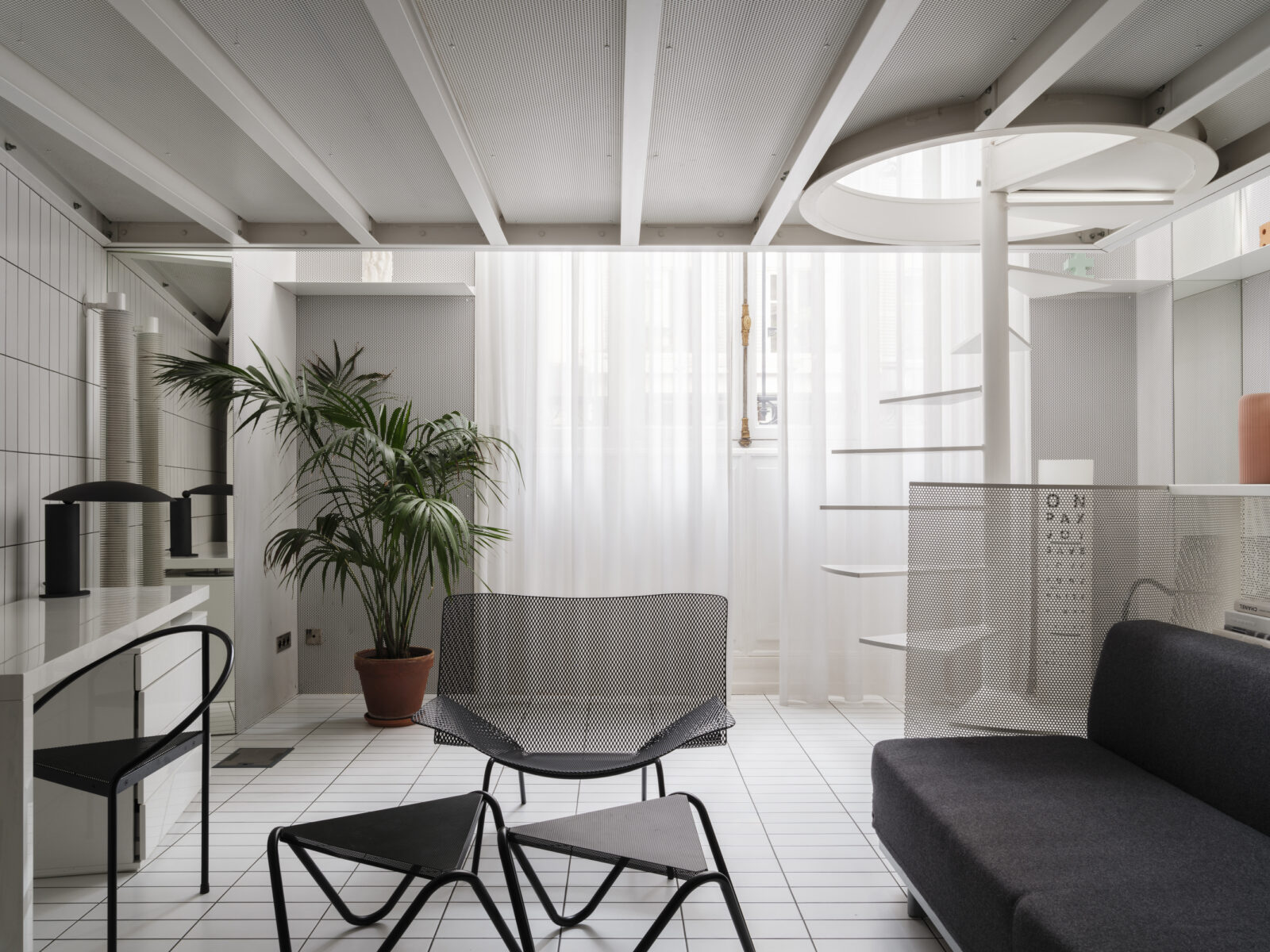
The unifying factor that runs through the properties is an insistence on quality materials. To wit, the materials used to breathe new life into the 25 square meters of each of the three floors of this apartment located just a stone’s throw from the Canal Saint-Martin, which was once a showroom for bronze foundrymen. “First and foremost, I didn’t want to use plasterboard, which is the non-sustainable element par excellence to me, not only in the ecological sense but also in the purely pragmatic sense of durability over time. I prefer raw materials such as ceramics, metal and wood, which are used here. As with food, I believe that the less processed, the better!” The neutrality of the monochromatic white, gray and chrome palette allows the decorative pieces to express themselves fully. The straight lines of the ceramic tiles are reminiscent of graph paper: “I didn’t just use them to accentuate verticality, to stretch space. You’ll think I’m crazy, but they form a grid to align the apartment’s treasures strategically.” And that’s how you know curating isn’t just for museums.