
 For Sloft+ members only

First of all, there’s a hulking trio of towers in the heart of the city: the 18-storey Labourdette Towers by Jacques Henri-Labourdette and Robert Boileau, built between 1958 and 1962 in Marseille’s Belsunce district. A superb example of post-war architecture, the reinforced concrete post-slab structures, which were once threatened with demolition but eventually awarded heritage status, offer generous, double-exposure apartments with immense openings. On one side, Notre-Dame de la Garde, Marseille’s iconic basilica on the hill; turn around for a view of the city’s distinctive pink-tiled roofs; now turn your head, and you get the Old Port, the sea and even the Frioul archipelago in the distance.
Then, there’s Clarisse and Valentin, a couple of architects looking for a perch to build a nest in. And, joy of joys, a 16th-floor apartment ready for them to bring that vision to life.
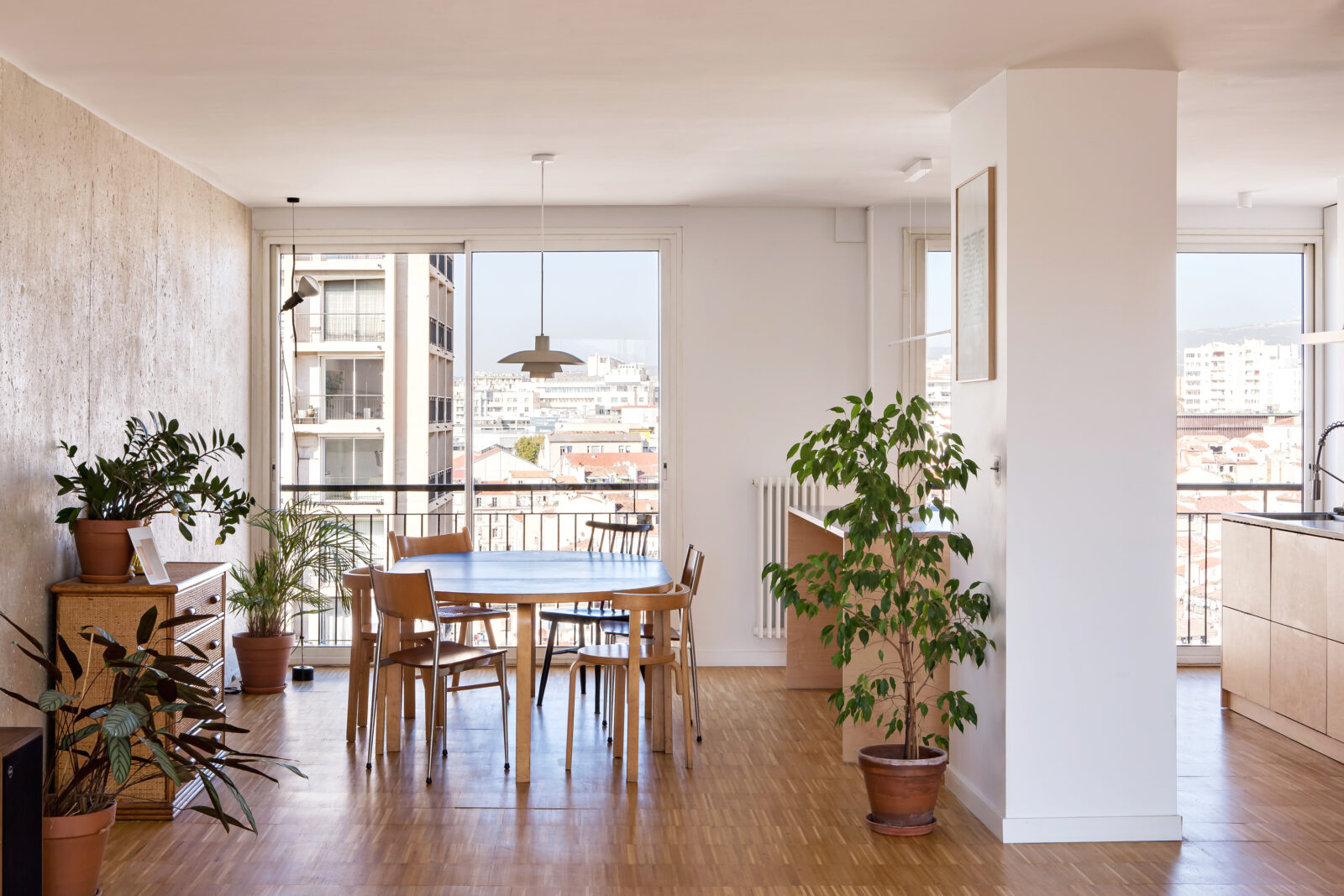
Ninety square meters, a single load-bearing column, the possibility of stripping everything bare to better reveal the structure of the building and its original materiality to bring the city in. The perfect playground for this duo of designers who are adept at a kind of absolute constructive truth – in other words, embellishment isn’t their thing. The concept is one word: open. It’s also more complicated than it seems, but that’s all in a day’s work when confronting the notion of an open plan, in which to create a simultaneously continuous and structured space, providing (almost) 360-degree perspectives on the city. All this, while integrating a bedroom (and the possibility to add another easily), a real living room, Valentin’s vinyl and books, a dining room – and, most importantly, a kitchen that serves as an epicurean daily-life hub.
“Although the eye can wander freely, each functional zone and each use is distinct and legible.” To achieve this, the architects rely on structuring elements, what they call “thick partitions,” primarily full-height storage units with recesses for sliding doors. An interplay of massing – and the absence of transoms – contribute to the fluidity and airy feeling of the space. That, and the sunlight of Provence shining on continuous and left untreated materials, like concrete, wood, and stainless steel. “It’s the first project we’ve worked on together. It made sense and turned out to be very concrete, allowing us to experiment and develop a common approach.” The perfect proof-of-concept led to the founding of their Belsunce studio.
