 For Sloft+ members only

Carlos and Aleks had been looking for an apartment in Madrid for some time, when they came across a small advertisement with a single, out-of-focus photo: “It was an odd composition that showed a wrought-iron railing, with an interesting curved shape that gave it a modernist touch. We felt there might be a hidden treasure behind it,” explains Carlos. And that intuition turned out to be true. The apartment, located just a stone’s throw from Atocha in the increasingly lively Palos de la Frontera district, “was a 70-square-meter diamond in the rough, with five balconies overlooking the street.”
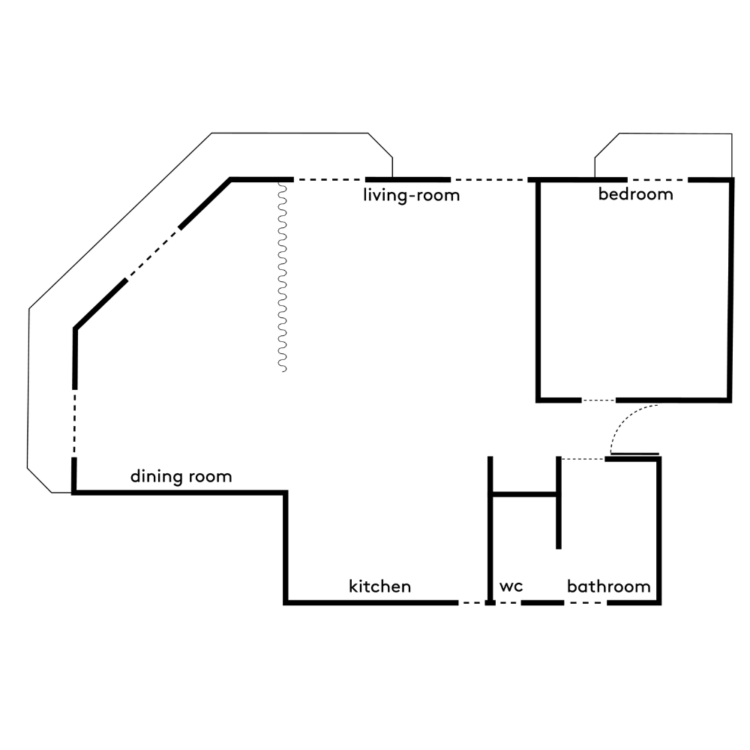
Architect Carlos is the founder of EstudioReciente, and Aleks is an interior architecture and design journalist. Naturally, they knew just what they wanted: “On top of a reasonable price, we were looking for something we could transform guilt-free, kind of like an ideas lab.” On the third floor of a Castillo-like 1920s corner building, they discovered a highly-partitioned apartment, typical of the period: “After a thorough gutting, we focused on its social function, combining the dining room, living room and kitchen into one 45-square-meter room,” Carlos explains.
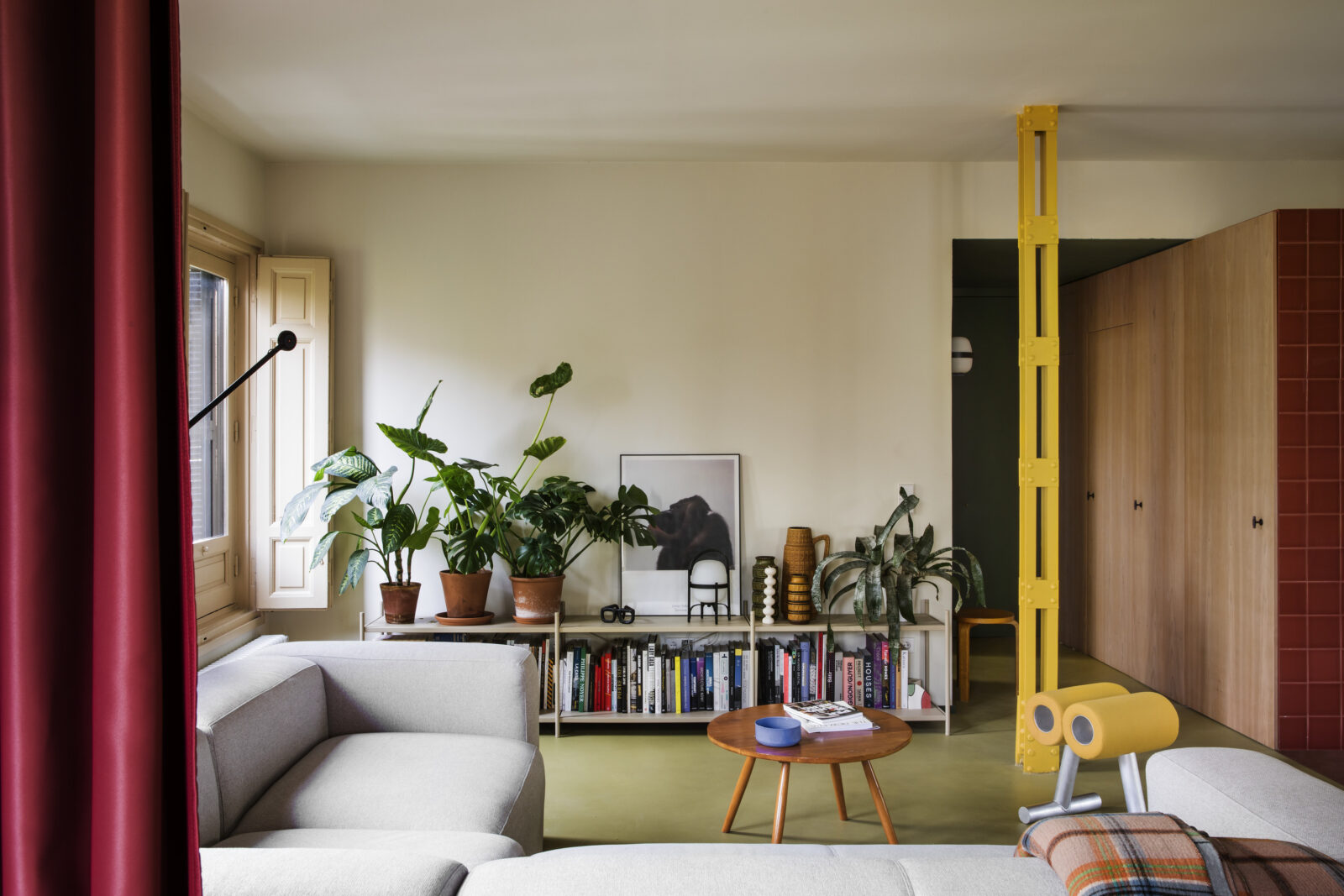
The apartment’s entire identity was about to change: “Despite the façade’s regionalist style, the project was inspired by the Sonneveld House (Rotterdam, 1930). I’ve always been a fan of its use of color and materials,” explains Carlos. To the question “Can one use too much color? ” the couple’s answer was to pick blue for the bathroom, yellow for the metal pillars, green for the lime mortar floor, and deep red for the large curtain separating the dining room from the living room.
“I’m glad Carlos had the idea of not completely merging the kitchen and living room,” says Aleks. The meal-preparation function is partially concealed behind a mirrored “totem” that houses functional elements such as the fridge and pantry, creating different pathways around the living space: “We only see what interests us,” says Carlos. Good show.
Fun was the order of the day, and so much fun was had. The couple indulged in all manner of materials, from the cherry wood for the bathroom doors and the two entrance hall cupboards, to the textiles used in the bedroom.
“Although that’s not very common in Spain, I’ve always wanted wall-to-wall carpeting – the sweetest taboo,” jokes Aleks. Carlos’ many plants were also taken into account from the outset: “They converse with the lush canopies of trees at the windows – the apartment’s greatest asset,” he explains. The former owner told them that the whole building had belonged, years ago, to Doña Manolita, the founder of the country’s most famous lottery. Clearly, her luck seems to have permeated the walls.