 For Sloft+ members only

It was in Amsterdam, in the working-class neighborhood of Transvaalbuurt, that Michiel Hilbrink and his partner Dongyoung Lee discovered, almost by chance, this 60-square-meter attic apartment in a brick building dating back to 1924. The photos in the listing didn’t look very promising, but when they visited, something clicked: “We immediately saw the potential! It was bigger and had higher ceilings than anything else we had seen. It had a definite loft feel. We knew we had to go for it right away,” says the architect, who has since sold the property.
A visual artist by training, Michiel turned to architecture a few years ago in search of stability, driven by a desire to design thoughtful and harmonious spaces. In 2024, he founded his agency (ardor-studio) and made this apartment his personal manifesto, with the ambition of preserving the brightness and feeling of space, while imagining a warm living space for two … then three.
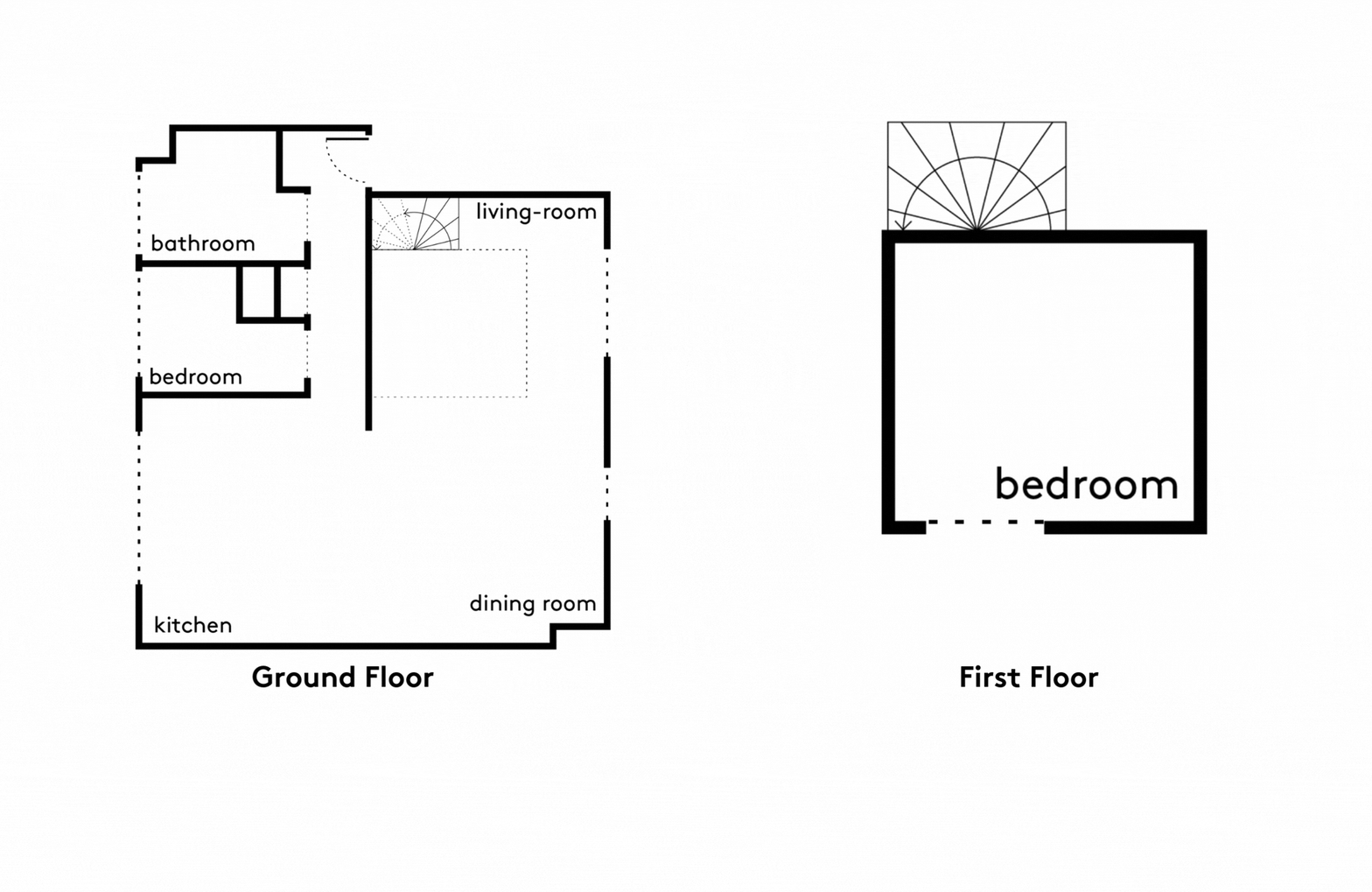
Rather than a compartmentalized layout, he imagined a large open-plan room, structured around the black kitchen island: “It’s not really about materials, but above all about color. Black creates a kind of gravitational force: you are naturally drawn to the countertop.” Another striking feature is the primary bedroom, which the architect chose to literally suspend, attached on one side to the apartment’s only load-bearing wall and on the other to the roof beams. “I didn’t want any posts, nor did I want to reduce the volume. It was better to have a small, well-designed bedroom than to sacrifice the living room!”
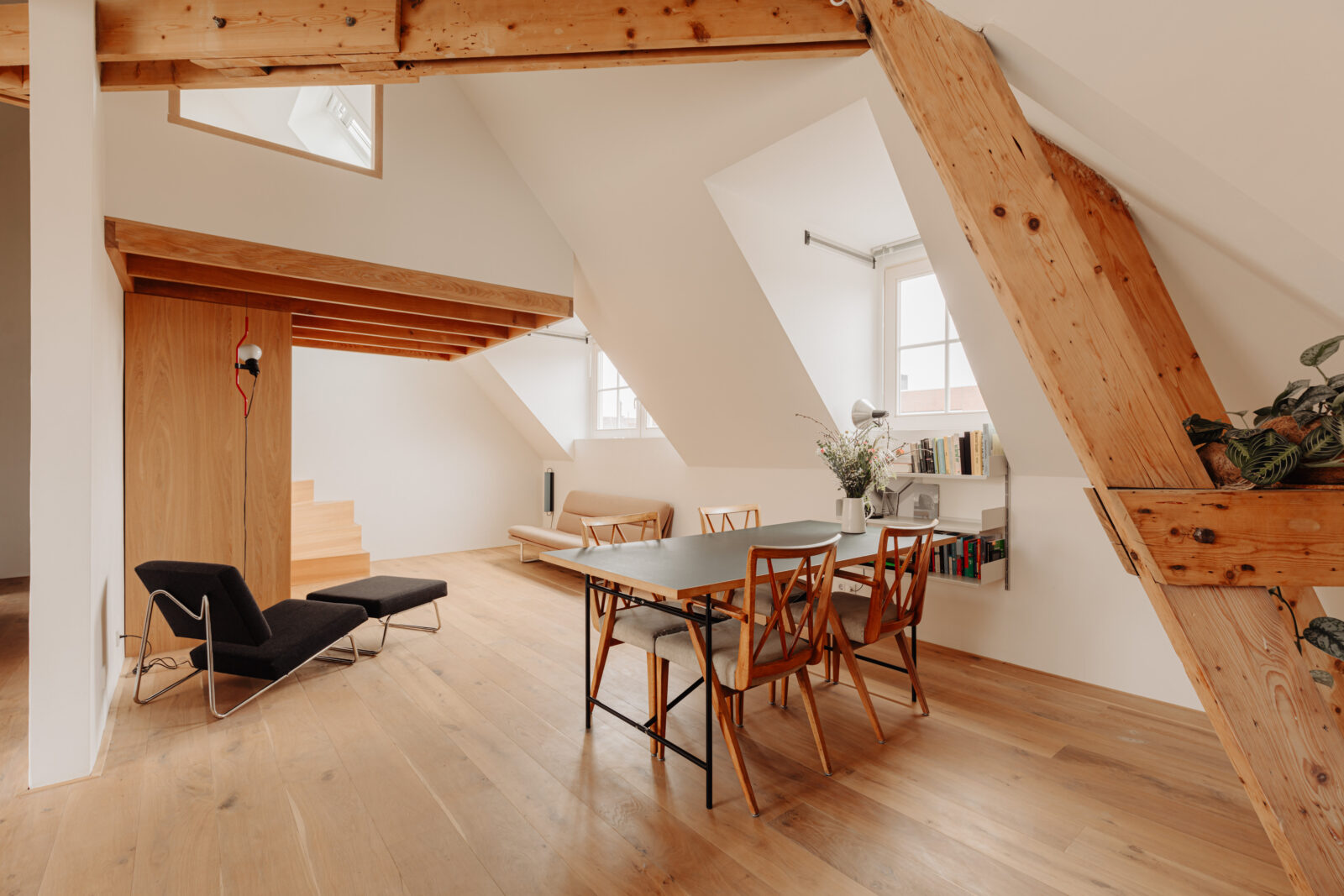
In terms of decoration, the couple opted for a limited but sophisticated palette: pristine white walls to capture the light, old pine beams left untreated, and custom-made oak cabinetry to complement the volumes of the space. In the bathroom, antique Winckelmans-style tiles (made in the same French factory) found in the north of the Netherlands, show off their patina. There is nothing ostentatious here, just a keen sense of modern comfort: reinforced insulation, discreet ventilation, natural thermal inertia, and controlled air quality.
The outcome? A peaceful interior, both timeless and minimalist, where every element has its place. A space designed to last, untouched by passing trends and focused on the essentials.