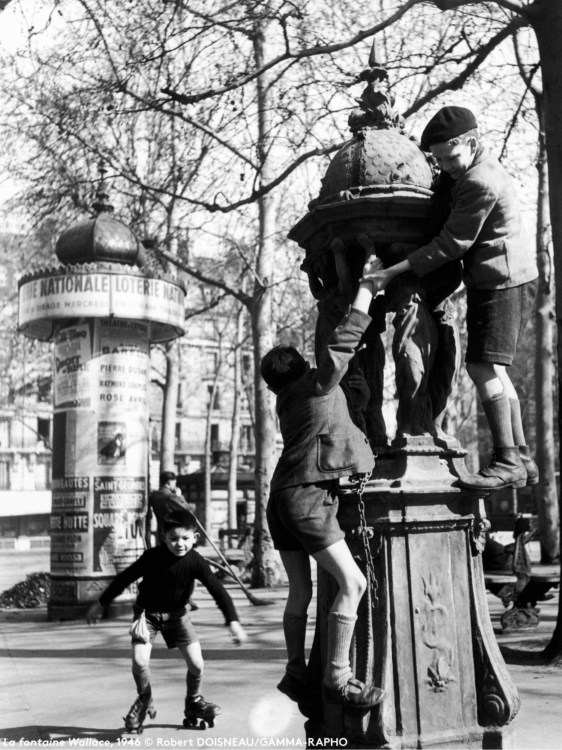
Think back to Robert Doisneau’s photographs. They show children running through the streets – agile, resourceful, and full of life; they climb fountains, do handstands on railings, and go off to buy milk or a loaf of bread all by themselves. They’re at home in the city, embodying a joyful, free-spirited childhood. Could we still witness such scenes today? How can we ensure that the city is once again the domain of the little ones – and, by extension, of everyone? And why should this be given a serious thought?
“There’s a handy indicator we use to measure children’s place in public space,” says Anne-Dominique Israel, who works on building child-scaled cities for the CEMÉA network, which promotes the implementation of innovative educational methods. “That would be the age at which they are allowed to walk around the city independently, such as to the bakery or school. This ‘independent mobility’ is essential to children’s development.” Italian research psychologist Francesco Tonucci shares this view. In his essay “The City of Children,” he stresses that “getting out of the house, wandering the streets on one’s own, finding one’s bearings in one’s environment, is an important dimension of a child’s social and cognitive development.” According to him, the age at which children should make their way to school by themselves should be six years old, but this is far from figures reported by Unicef in a study published in 2021, which concludes that in cities with populations over 100,000, only 3% of elementary school children get there on their own.
Nous utilisons des cookies pour vous garantir la meilleure expérience sur notre site web. Si vous continuez à utiliser ce site, nous supposerons que vous en êtes satisfait.

 For Sloft+ members only