Isn’t it every architect’s dream to build the smallest possible house that’s both minimalist and practical?
It’s the solution to the ideal of a life devoid of artifice, which finds it origins in the myth of Diogenes, the beggar philosopher who lived a life of deprivation in a wine barrel, allowing room for thought alone. Or in Henry David Thoreau’s Walden, in which the author spent two years living in a cabin on the edge of a pond. Despite being published in 1854, this ode to a return to nature still resonates today, as we question the meaning of our hectic lives heightened by a global pandemic and a planet heavily impacted by our actions. Gone are ostentatious McMansions, pointless square meters and empty holiday homes which cost a fortune to maintain. It’s time to go back to basics and simple needs. Well, at least for a holiday or when there’s a lull in work. Head into nature, far from the madding crowd. De-connect to reconnect.
Even Le Corbusier himself, the first of the starchitects, had a go at this stylistic exercise in the 1950s.
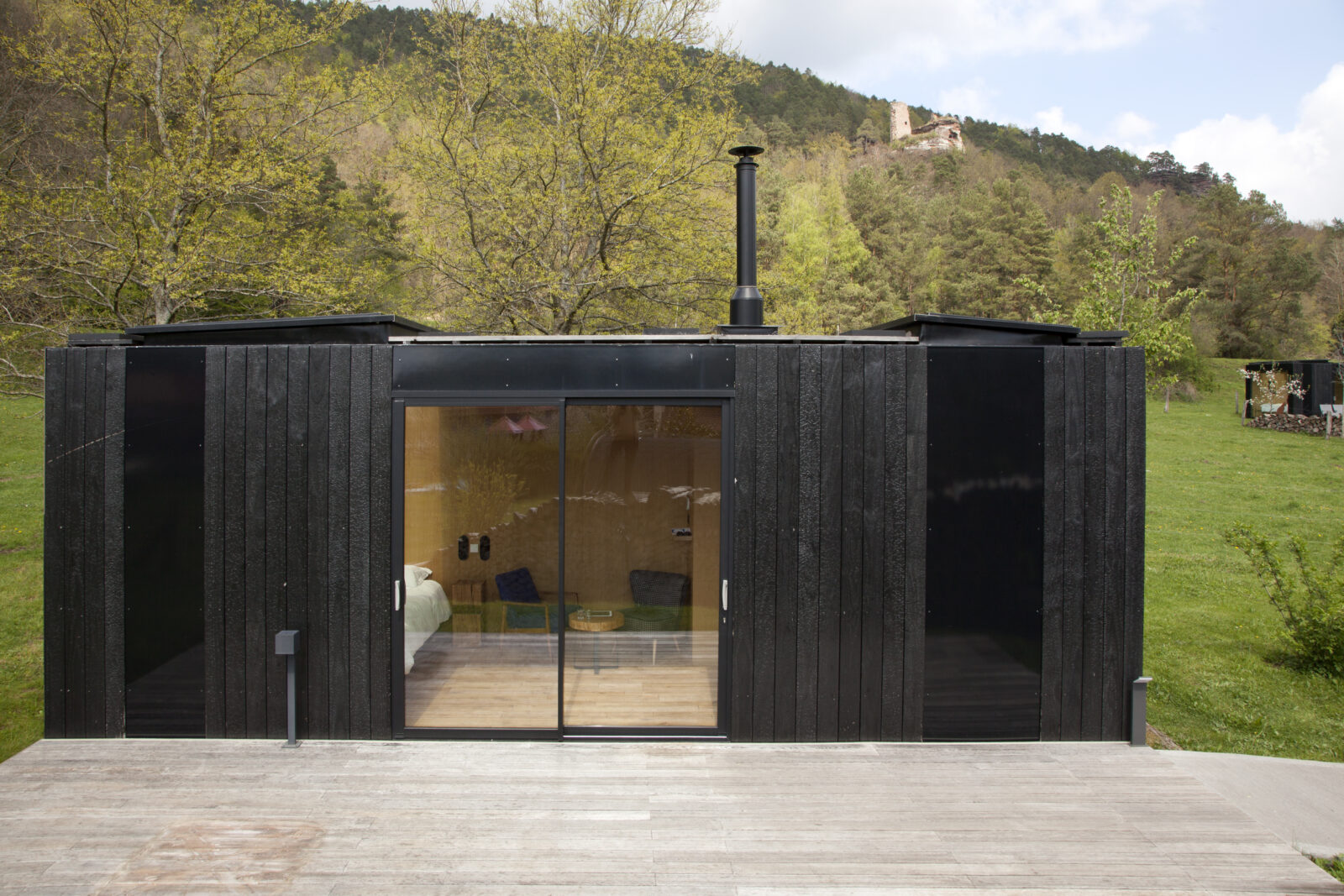
His 16 m² cabin located in Roquebrune-Cap-Martin near Nice was the beginning of a long line of tiny, prefabricated buildings that, more often than not and just as he had imagined, could be reproduced on an industrial scale for the masses to enjoy. In our interview with Tim Benton, he explains how Le Corbusier championed Diogenes’ legacy and chose to deck his cabin with the last boards of a log, those rustic-looking wood offcuts that evoked the image of a Canadian log cabin rather than a holiday home on the Mediterranean coast. It’s a display of ostensible simplicity, when you know the level of hard work that went into designing his basic living unit. And when Anseau Delassalle launched his Novablok concept nearly seven decades later, he certainly reinterpreted the compact nature of Le Corbusier’s cabin, adding a privileged relationship with the outdoors, one conductive to contemplation, even in latitudes less favored by the sun’s beaming rays. Tiny house, cabin, folly... Whatever you want to call it, its minimalism and frugality enrapture our dreams – our most affordable dreams at that – to the point of wondering why, after all, we wouldn’t live there all year round, like a thoroughly modern Thoreau?
Cabanon de vacances designed by Le Corbusier in Roquebrune-Cap-Martin
Nous utilisons des cookies pour vous garantir la meilleure expérience sur notre site web. Si vous continuez à utiliser ce site, nous supposerons que vous en êtes satisfait.


 For Sloft+ members only